

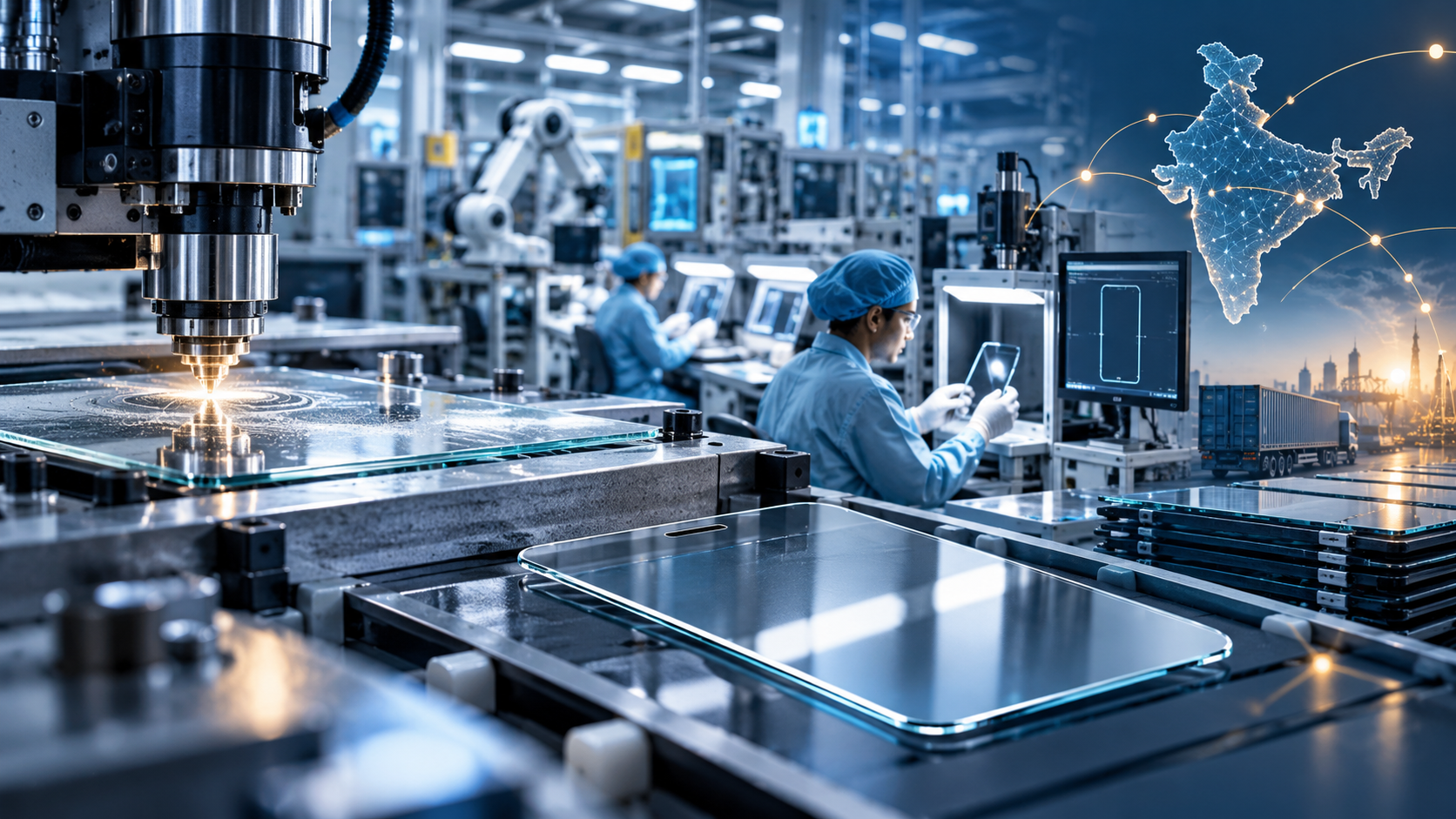
India has built significant scale in smartphone manufacturing, but the next stage of growth depends on how much of the component value chain can also be developed locally. One important area in this transition is the localisation of cover glass manufacturing and finishing in India.
Mobile cover glass is the protective outer glass integrated into a smartphone or other consumer electronic device. Producing a finished cover glass part requires precision cutting, shaping, edge finishing, strengthening, cleaning, decoration and strict quality control. This is why mobile cover glass manufacturing is relevant not only as a component opportunity, but as part of India's move towards deeper electronics localisation.
Why Cover Glass Localisation Matters Now
India's electronics industry has expanded rapidly over the past decade. Government data for FY2025-26 estimates electronics production at around ₹13.11 lakh crore and electronics exports at around ₹4.24 lakh crore. Mobile phone production reached approximately ₹6.27 lakh crore during the same period.
That scale changes the localisation opportunity. When final device manufacturing becomes large, the business case for developing nearby component processing, sub-assemblies, materials, testing and engineering capability becomes stronger.
Cover glass manufacturing in India fits directly into this next phase because smartphones require large volumes of highly consistent glass parts that meet tight dimensional, optical and cosmetic specifications.
What Is Mobile Cover Glass?
Mobile cover glass is the protective glass layer at the exterior of a smartphone. On the front, it sits above the display system and provides the surface users see and touch. Depending on the design, glass may also be used on the rear of the device.
A finished cover glass component needs to combine optical clarity, thinness, dimensional accuracy, damage resistance and compatibility with cameras, sensors and touch interfaces. It also needs to maintain that consistency at mass production volumes.
What Does Mobile Cover Glass Manufacturing Involve?
The exact sequence varies by material, customer specification and product design, but downstream mobile cover glass manufacturing can involve several important stages.
Precision Cutting and Shaping
Specialty glass material must be processed into the exact dimensions and geometry required by the device. Manufacturing may need to account for camera areas, sensors, openings and edge profiles.
Edge Finishing
Edges require careful grinding, polishing or other finishing processes. Small defects introduced during cutting can affect strength, appearance or fit during final device assembly.
Chemical Strengthening
Cover glass may undergo chemical strengthening to improve resistance to surface damage and crack propagation. The process must be controlled according to the glass composition and required product performance.
Cleaning, Decoration and Inspection
Optical surfaces must remain free from particles and process residue. Depending on the product, decoration, printing or functional surface treatments may also be required. Final inspection checks dimensions, cosmetic defects, edge quality and optical appearance.
This combination of precision processing and quality control explains why cover glass manufacturing in India is more technically demanding than simply cutting ordinary glass to size.
Does Local Manufacturing Mean the Entire Glass Value Chain Is Local?
Not necessarily. Localisation can happen in stages.
A finished cover glass facility in India may perform cutting, shaping, strengthening, finishing, decoration and inspection while the specialty base glass or certain process materials are sourced separately. Over time, production scale can support a broader local ecosystem around equipment, chemicals, fixtures, packaging and engineering.
Meaningful localisation does not require every upstream input to become domestic on day one. Moving an important processing stage into India can still increase domestic value addition and reduce dependence on a fully imported finished component.
How Localisation Can Strengthen the Electronics Supply Chain
For smartphone OEMs and electronics manufacturers, local mobile cover glass manufacturing can create several practical advantages.
Shorter Supply Chains
Processing components closer to device assembly facilities can reduce some international logistics, customs exposure, inventory buffers and replenishment time. Total cost still depends on yield, utilisation, materials, energy and manufacturing efficiency.
Faster Engineering Feedback
Smartphones operate on frequent product development and launch cycles. Closer coordination between device manufacturers and component suppliers can support qualification, design changes, yield improvement and production ramp-up.
Greater Supply Chain Resilience
Developing qualified capacity across more than one geography can reduce concentration risk. India's opportunity is to become an additional reliable node in the global electronics supply chain.
Higher Domestic Value Addition
As more precision component processes are performed locally, a greater share of the finished device's manufacturing value can be created within India. This is one reason cover glass manufacturing in India has strategic importance beyond the glass component itself.
Why Cover Glass Is Difficult to Localise
Precision cover glass production has a relatively high technical barrier. Commercial success depends on repeatability, yield and customer qualification, not just the ability to manufacture a sample.
Manufacturers need expertise in materials, machining, chemical processing, metrology, automation and inspection. Smartphone designs also have tight tolerances, so even small dimensional or cosmetic variations can create issues during final assembly.
OEM qualification is another major requirement. Suppliers must demonstrate that their processes can consistently meet technical, quality and volume expectations before commercial programmes can scale.
How Optiemus and BIGTech Fit Into the Localisation Journey
Optiemus Infracom and Corning International Corporation established Bharat Innovative Glass Technologies Private Limited, or BIGTech, as a joint venture focused on finished cover glass parts for mobile consumer electronics in India.
The BIGTech facility is located at SIPCOT Pillaipakkam Industrial Park in Kanchipuram District, Tamil Nadu. The project adds an upstream component capability to Optiemus' broader electronics manufacturing capabilities.
According to Optiemus' Q1 FY2026-27 update, the facility was ready and OEM qualification activity was underway, including plant visits, audits and technical trials. Commercial onboarding remains dependent on successful customer qualification and programme requirements.
This initiative illustrates how mobile cover glass manufacturing can connect global materials expertise with Indian precision processing and electronics manufacturing capability.
What Should Smartphone OEMs Evaluate in a Cover Glass Supplier?
OEMs should assess more than local presence. Important factors include process capability, dimensional consistency, material compatibility, production yield, inspection systems, traceability, scale-up capability and long-term engineering support.
They should also evaluate the availability of upstream materials, consumables and equipment because supply chain resilience depends on the complete process, not only the location of the finishing plant.
The Bigger Opportunity for India's Electronics Industry
Cover glass manufacturing in India represents one part of a broader shift from large-scale electronics assembly towards a deeper component ecosystem.
As India develops more capability in precision components, materials, sub-assemblies, tooling, testing and manufacturing technology, OEMs gain access to a more complete domestic supply base. This can support specialised skills, supplier development and higher-value engineering activity.
Optiemus' broader evolution across mobility, electronics manufacturing and technology platforms can be explored through its corporate journey. Its consumer technology portfolio can also be viewed on the Optiemus brands page.
Conclusion
India has already demonstrated that it can manufacture smartphones at a significant scale. The next challenge is to build more of the component and process ecosystem behind those devices.
Local cover glass capability can support shorter supply chains, closer engineering collaboration, resilience and higher domestic value addition. At the same time, the technical demands of mobile cover glass manufacturing show why deeper localisation requires precision, process control, strong yields and successful OEM qualification.
As India's electronics manufacturing sector moves further upstream, finished cover glass can become an important example of how component localisation strengthens the wider supply chain.
Frequently Asked Questions
What is mobile cover glass?
Mobile cover glass is the protective outer glass component integrated into a smartphone or other electronic device. It protects the underlying display while providing optical clarity and a touch surface.
Why is cover glass manufacturing in India important?
Local production can deepen India's electronics component ecosystem, support domestic value addition, reduce some geographic supply chain concentration and enable closer collaboration with smartphone manufacturers.
Is mobile cover glass the same as a screen protector?
No. Mobile cover glass is part of the device itself, while a screen protector is an aftermarket accessory placed over the existing cover glass.
What should OEMs evaluate in a cover glass supplier?
OEMs should evaluate process capability, quality consistency, yield, material compatibility, inspection, traceability, production scale, supply chain resilience and long-term engineering support.
