

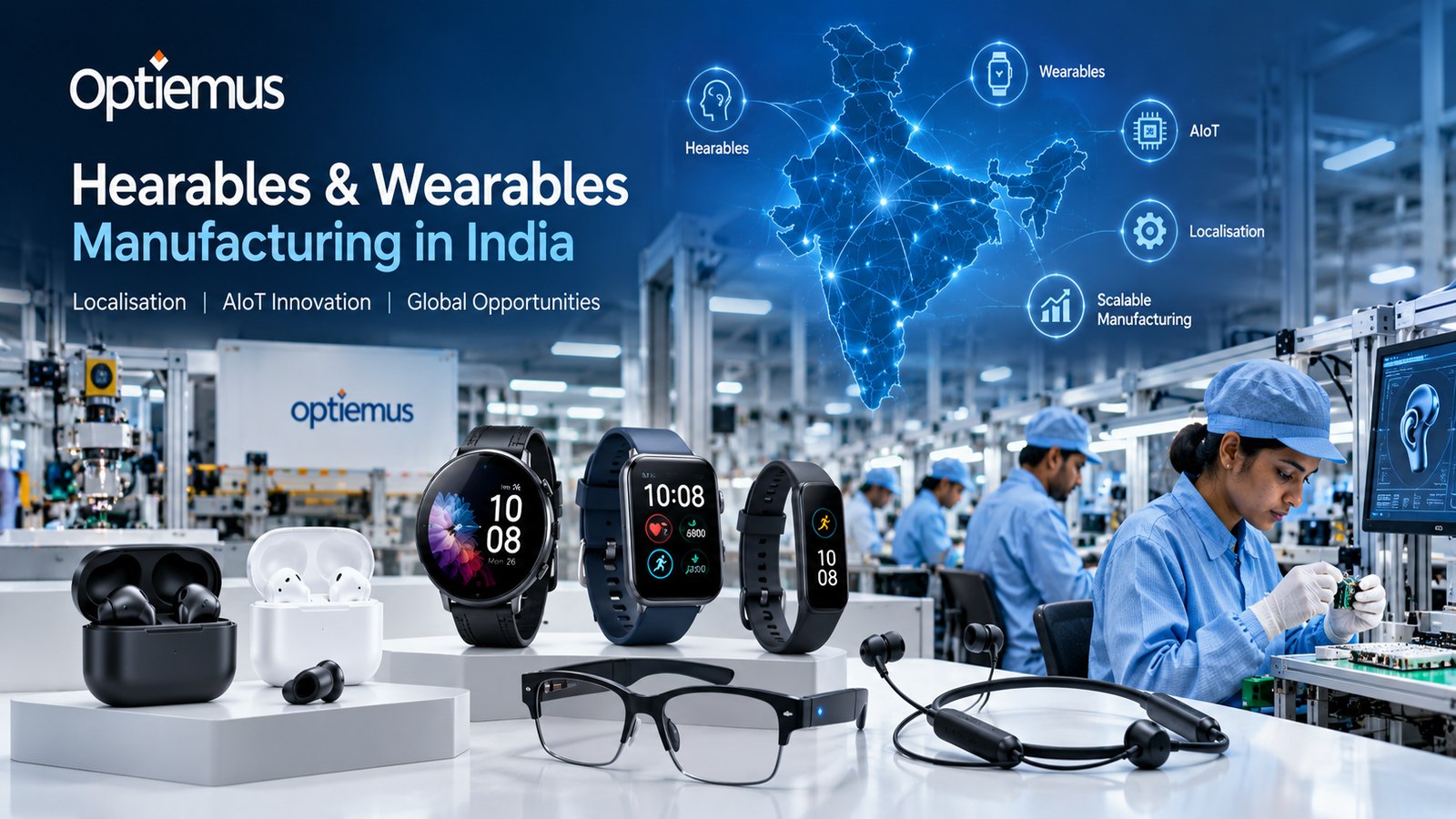
Hearables and wearables have evolved far beyond basic audio accessories and step counters. Today, the category includes TWS earbuds, smartwatches, fitness devices, open-ear audio products and other connected devices that combine sensors, software, artificial intelligence and cloud connectivity.
For consumer electronics brands, this evolution is changing the manufacturing conversation as well. Hearables and wearables manufacturing in India is no longer only about assembling finished products closer to the market. The opportunity is increasingly about localisation, faster product introduction, stronger quality control and the ability to support more complex AIoT-enabled hardware.
India's electronics manufacturing ecosystem is also moving deeper into components, sub-assemblies and domestic value addition. For brands planning their next product cycle, the key question is how much of the product lifecycle can progressively be built, tested and scaled in India.
Why Hearables and Wearables Are Entering a New Phase
The market is becoming more mature and competitive. Price and basic specifications alone are becoming weaker differentiators as consumers expect better battery life, connectivity, sensor accuracy, audio performance and intelligent features.
At the same time, hearables are expanding into use cases such as voice assistance, adaptive audio, translation and health-related sensing. Wearables are also moving into smart rings, connected glasses and other specialised form factors.
For brands, this means future growth will depend more heavily on product differentiation, engineering quality and reliable execution. That directly increases the importance of wearables manufacturing in India, where production systems need to support tighter electronics integration and more demanding testing requirements.
How AIoT Is Changing Manufacturing Requirements
AIoT combines artificial intelligence with connected devices. This is especially relevant to hearables and wearables because these products continuously interact with users, sensors, smartphones and cloud services.
A modern device may need to collect information from multiple sensors, process or transmit data, manage power efficiently and communicate reliably with a smartphone or other connected system.
As product complexity increases, manufacturing needs tighter control across PCB assembly, firmware loading, calibration, RF behaviour, battery performance, sensor validation, functional testing and final quality checks.
AIoT growth therefore creates more than a software opportunity. It raises the standard expected from hearables and wearables manufacturing in India and makes process discipline increasingly important.
What Localisation Means for Hearables and Wearables
Localisation should not be confused with simply moving final assembly from one country to another. A practical localisation strategy usually develops in stages.
A brand may begin with local assembly, testing and packaging, then progressively evaluate PCB assembly, mechanical parts, tooling, batteries, selected sub-assemblies and supplier development as volumes and economics become viable.
Important areas can include:
- PCB and PCBA assembly for greater local electronics capability
- Mechanical parts, charging cases and tooling
- Audio, RF, battery, sensor and functional testing
- Final assembly, testing and packaging
- Supplier development for components and materials
Not every component needs to be localised from day one. For many brands, a phased approach creates a more practical balance between speed, cost, quality and supply-chain maturity.
Why India's Electronics Ecosystem Matters
Hearables and wearables share parts of the same manufacturing ecosystem used by smartphones, telecom products, computing devices and other connected electronics.
As domestic capability around PCB assemblies, batteries, electro-mechanical parts, enclosures, testing and related processes develops, brands have more opportunities to increase local value addition.
A stronger base for wearables manufacturing in India can also support better production planning, closer engineering collaboration, shorter replenishment cycles and greater visibility into manufacturing operations.
What Opportunities Does Local Manufacturing Create for Brands?
Faster Product Introduction
Hearables and wearables have short product cycles. New sensors, chipsets, designs and feature expectations can change quickly. A manufacturing partner that supports New Product Introduction, engineering validation and production ramp-up can help reduce the gap between development and mass production.
Greater Control Over Quality
Small connected devices often contain tightly packed PCBs, batteries, microphones, antennas and sensors. Minor process variations can affect performance or reliability. Local manufacturing can give brands closer access to manufacturing and quality teams when strong systems are in place.
More Resilient Supply Chains
Localisation does not eliminate global supply-chain risk, but developing local assembly, sourcing and supplier alternatives can reduce dependence on a single geography or manufacturing route.
Support for Broader AIoT Portfolios
Brands are increasingly building connected ecosystems rather than standalone products. A company may sell smartphones, TWS products, smartwatches, IoT devices and smart accessories together. Working with a manufacturing ecosystem that can support multiple electronics categories can simplify scale and portfolio expansion.
A Path to Higher Domestic Value Addition
Local assembly is often the starting point. As volumes stabilise and supplier capability improves, brands can evaluate deeper localisation where it makes technical and commercial sense.
What Should Brands Evaluate in a Manufacturing Partner?
Choosing a partner for hearables and wearables manufacturing in India should involve more than comparing unit prices.
Brands should evaluate capabilities across Surface Mount Technology, Manual Insertion, final assembly, testing and packaging, along with NPI support, reliability testing, production scalability, traceability and supply-chain management.
Traceability matters because connected devices can involve multiple firmware versions, PCB revisions, components and test parameters. Brands should also understand whether the partner can scale smoothly from pilot production to mass manufacturing.
A Practical Localisation Roadmap
A phased roadmap can help brands balance speed, economics and supply-chain maturity.
Phase 1: Establish local product industrialisation, assembly, testing and quality benchmarks.
Phase 2: Expand into PCB assembly, tooling, mechanical parts, packaging and selected sub-assemblies.
Phase 3: Deepen component localisation through qualified domestic suppliers where commercially viable.
Phase 4: Build for larger domestic volumes and potential export programmes once quality, cost and supply continuity are stable.
The right roadmap will vary by product. A premium smartwatch with multiple sensors has different requirements from an entry-level TWS product, so localisation should follow the product architecture rather than a fixed template.
Optiemus and the Manufacturing Ecosystem
Optiemus Infracom has been part of India's mobility and electronics ecosystem for more than three decades. Through Optiemus Electronics Limited, the group manufactures categories including mobile devices, IT hardware, telecom products and hearables and wearables.
Its electronics manufacturing capabilities in India include Manual Insertion, Surface Mount Technology and Final Assembly, Testing & Packaging, supporting the journey from electronics assembly to mass production.
Optiemus has also recorded a manufacturing milestone of one million hearable and wearable devices in a single month, demonstrating existing scale in the category.
The Opportunity Ahead
The next phase of hearables and wearables manufacturing in India will depend less on final assembly alone and more on the ability to combine localisation, electronics engineering, quality systems, AIoT requirements and supply-chain execution.
For brands, manufacturing should increasingly be treated as part of product strategy. AIoT is increasing device complexity, consumers expect better experiences and India's electronics ecosystem is moving deeper into components and sub-assemblies.
Brands planning new hearable, wearable or connected-device programmes can discuss their manufacturing requirements with Optiemus and evaluate a production roadmap aligned with product complexity, target volumes and localisation goals.
Frequently Asked Questions
What are hearables and wearables?
Hearables include connected audio products such as TWS earbuds and wireless earphones. Wearables include smartwatches, fitness trackers, smart rings, connected glasses and other electronics designed to be worn by users.
Why are brands considering hearables and wearables manufacturing in India?
India offers growing capabilities across electronics assembly, testing and component ecosystems. Local manufacturing can support phased localisation, closer engineering coordination and scalable production.
How is AIoT affecting wearable manufacturing?
AIoT-enabled devices combine connectivity, sensors, software and intelligent functionality. This increases requirements around PCB assembly, firmware, calibration, battery management, functional testing and traceability.
What should brands look for in a manufacturing partner?
Brands should evaluate electronics assembly, NPI support, testing, quality systems, traceability, supply-chain management and the ability to scale from pilot runs to mass production.
