

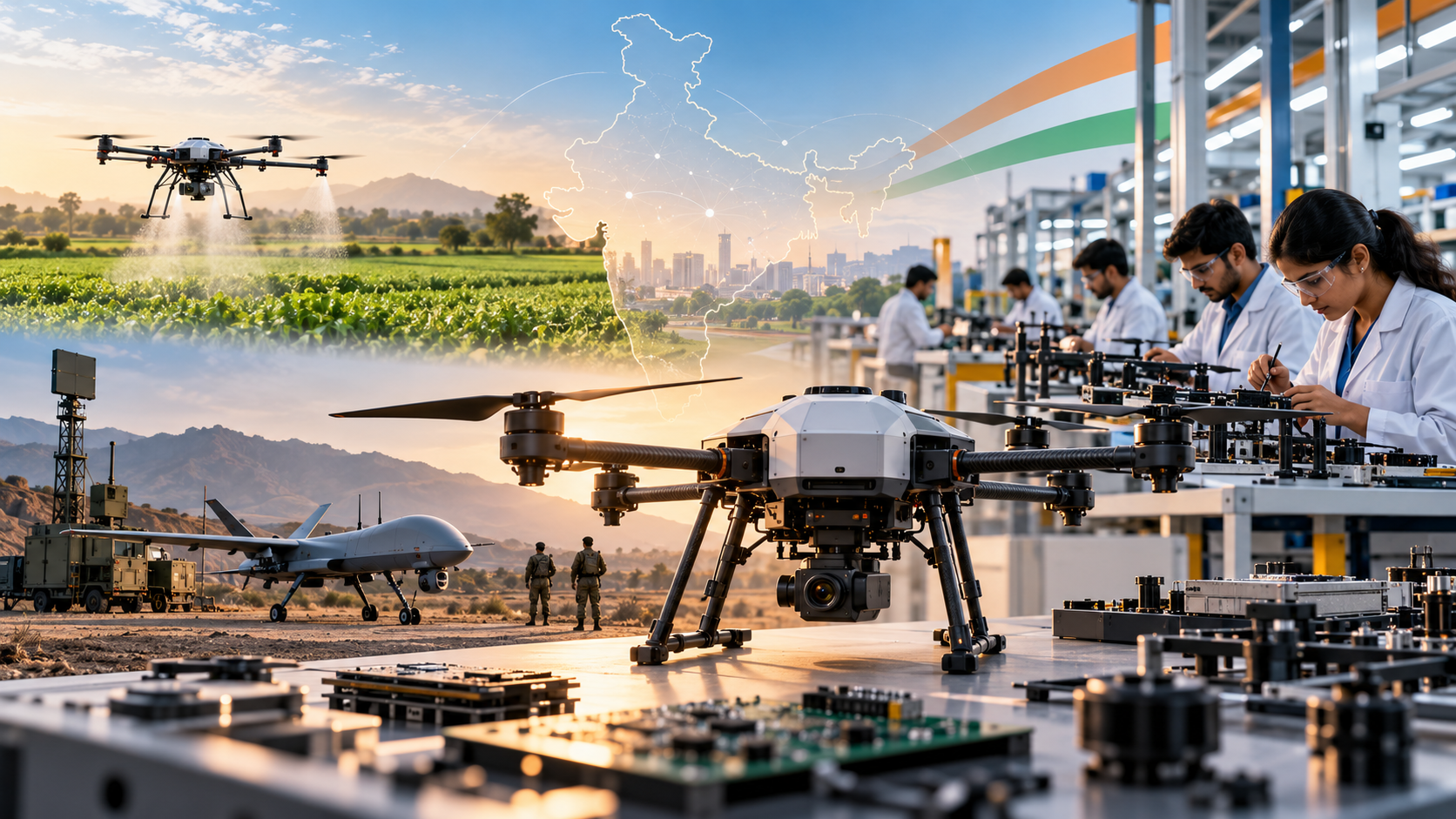
India's drone ecosystem is moving from early adoption to deeper manufacturing capability. Drones are now being used across defence, agriculture, surveying, infrastructure, energy and industrial applications, while policy and industry attention is increasingly focused on building more of the technology within the country.
That shift is important because drone manufacturing in India is not only about assembling an imported platform locally. A strong domestic ecosystem also depends on the ability to design, source, integrate, test and support critical systems such as airframes, propulsion, flight electronics, batteries, navigation, communication systems, payloads and software.
For brands, enterprises and institutions evaluating the sector in 2026, the opportunity lies in understanding where localisation is becoming practical, which applications are creating demand and what capabilities matter when selecting drone manufacturers in India.
Where India's Drone Ecosystem Stands in 2026
India has built a more structured regulatory and operating environment for drones over the past few years. Government information published in February 2026 reported more than 38,500 registered drones, 39,890 certified remote pilots and 244 approved Remote Pilot Training Organisations across the country.
Policy measures such as the Drone Rules, the Production Linked Incentive framework for drones and drone components, and sector specific adoption programmes have helped create the foundation for a wider market. The next phase is increasingly about developing domestic technology depth rather than focusing only on final assembly.
This makes drone manufacturing in India relevant not just as a production opportunity, but also as a supply chain, engineering and strategic capability.
Why Indigenous Components Matter
A modern drone is a tightly integrated combination of hardware and software. Even when final assembly happens locally, dependence on imported motors, flight controllers, batteries, sensors, cameras, navigation modules or communication systems can create supply and product development risks.
Deeper localisation can improve supply chain resilience, give engineering teams greater control over product customisation and shorten the feedback loop between field performance, design changes and the next production build.
Priority areas for indigenous capability can include:
- Flight controllers, autopilot electronics and power distribution systems
- Motors, propellers and electronic speed controllers
- Battery packs, battery management systems and charging solutions
- Navigation, telemetry and communication modules
- Camera systems, gimbals and application specific payloads
- Airframes, structural parts and composite components
- Embedded software, mission control and AI enabled analytics
Defence Is Raising the Bar for Domestic Drone Capability
Defence is one of the strongest drivers of indigenous drone development because operational requirements can be significantly more demanding than standard commercial applications. Surveillance, reconnaissance, logistics, mission specific payloads, secure communications and operation in challenging environments all require a high level of engineering and testing.
In March 2026, India's Defence Minister called for the country to work in mission mode to become a global hub for indigenous drone manufacturing, with emphasis on building a complete domestic production ecosystem.
For drone manufacturers in India, this creates opportunities beyond complete aircraft. Companies specialising in electronics, optics, sensors, communications, batteries, AI, propulsion and materials can also become part of the defence drone value chain.
Agriculture Is Creating a Different Path to Scale
Agriculture represents another important use case, but the engineering and business requirements are different from defence. Agricultural drones can support precision spraying, crop monitoring, field mapping and data collection.
The Namo Drone Didi programme has also helped demonstrate a service based model for agricultural drone adoption. Government information published in February 2026 stated that 1,094 drones had been distributed to women Self Help Groups, including 500 under the Namo Drone Didi scheme.
For agriculture, product design needs to consider practical factors such as payload capacity, spraying system integration, flight stability under load, battery change workflows, ease of maintenance, operator usability and resistance to dust and field conditions.
This is why successful drone manufacturing in India will increasingly depend on mission specific product development rather than one generic platform being used for every sector.
Market Opportunities Beyond Defence and Agriculture
The commercial opportunity extends across industries where aerial access, repetitive inspection or large area data collection can improve efficiency.
Mining companies can use drones for surveying and site monitoring. Solar farms and energy operators can use aerial systems for asset inspection. Oil and gas companies can monitor difficult to access infrastructure. Railways and highways can use drones for mapping, construction monitoring and inspection. Drone based surveying has also been used at scale under the SVAMITVA programme for village mapping and property records.
These applications show that the value of a drone often comes from the complete solution, including the aircraft, payload, software, data processing, operator workflow and support.
What Should Businesses Evaluate in a Drone Manufacturing Partner?
Businesses comparing drone manufacturers in India should begin with the application rather than headline specifications. The right platform for agricultural spraying may be unsuitable for mapping, surveillance or industrial inspection.
Key areas to evaluate include design and manufacturing capability, component sourcing, localisation strategy, testing and reliability, payload integration, software architecture, data handling, repairability and long term technical support.
Buyers should also understand how much of the product is designed and integrated by the manufacturer and which critical components depend on external suppliers. This becomes particularly important when a fleet needs replacement parts, upgrades or product modifications over several years.
Optiemus and India's Drone Manufacturing Ecosystem
Optiemus Infracom has expanded its manufacturing portfolio into unmanned systems through Optiemus Unmanned Systems Private Limited (OUS), a wholly owned subsidiary focused on the design and manufacturing of drones.
According to Optiemus' manufacturing capabilities page, OUS is focused on indigenous drone solutions for applications including defence, agriculture, mining, solar farms, oil and gas, railways and highways. This places drones alongside Optiemus' broader electronics manufacturing activities and reflects the growing convergence between electronics manufacturing, embedded systems, sensors, software and application specific hardware.
Businesses exploring the wider group can also review Optiemus' corporate journey and technology capabilities.
What Will Define the Next Phase?
The next phase of drone manufacturing in India will be defined less by how many companies can assemble a drone and more by how much technology depth the ecosystem develops.
Manufacturers will need to improve local component capability, application specific engineering, testing, production scalability and lifecycle support. At the same time, software, AI, computer vision and mission management will continue to add value to the physical platform.
For defence, the priority is strategic autonomy and dependable technology. For agriculture, it is practical deployment at scale. For industrial users, it is reliable data collection, inspection and operational efficiency.
As these requirements mature, the strongest opportunity is to build an integrated ecosystem in which hardware, components, software, payloads and support work together. Organisations evaluating new drone programmes can contact Optiemus to discuss manufacturing and technology requirements.
Frequently Asked Questions
What is driving drone manufacturing in India in 2026?
Growth is being supported by defence requirements, agricultural adoption, industrial use cases, government policy and increasing focus on local component and technology development.
Why is indigenous drone manufacturing important?
Indigenous capability can improve supply chain resilience, support product customisation, strengthen lifecycle support and reduce dependence on limited overseas sources for critical technologies.
Which industries are creating demand for drones in India?
Major opportunities include defence, agriculture, mining, energy, oil and gas, railways, highways, surveying and industrial inspection.
What should businesses look for in drone manufacturers in India?
Businesses should assess application fit, product design capability, component sourcing, testing, payload integration, software, repairability, scalability and long term technical support.
