

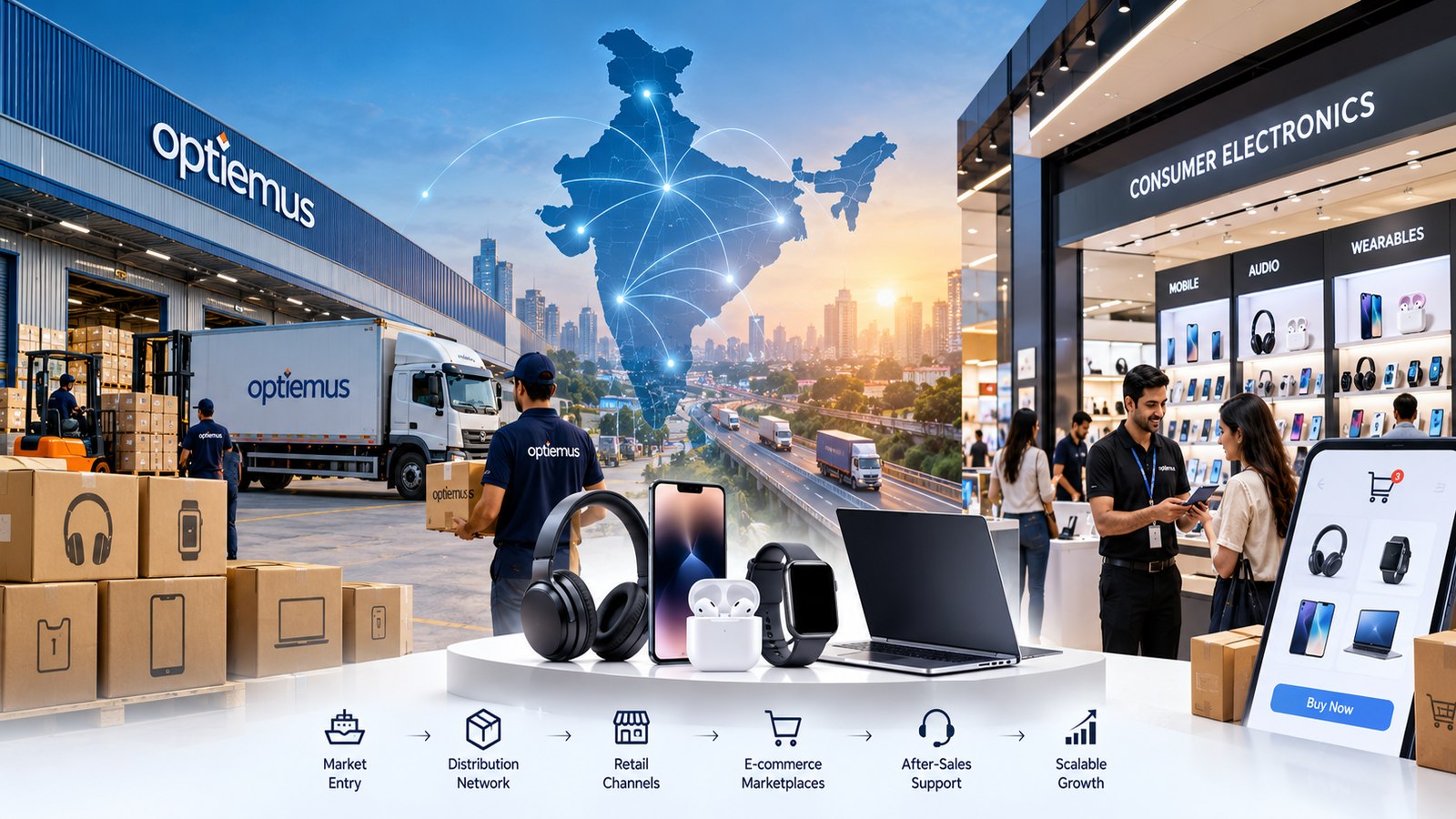
India offers major opportunities for global consumer electronics brands, but building a sustainable business requires more than importing products and appointing a distributor. Brands need a route to market that connects products with customers through distribution, retail, e-commerce, pricing, inventory and after-sales support.
For brands entering the country, consumer electronics distribution in India should be treated as a complete go-to-market system. The objective is a scalable network that generates sell-through, protects channel economics and expands based on evidence.
Why India Needs a Local Go-to-Market Strategy
India is not one uniform electronics market. Customer behaviour differs by category, price band, geography and city tier, so a premium headset, smartphone, wearable or connected device may require a different channel mix.
Consumers may discover a product online, compare it on marketplaces and purchase through another channel. Pricing, retail execution, inventory and service therefore need to work together.
Before building consumer electronics distribution in India, a global brand should define its target customer, priority markets, product-channel fit, pricing structure, service model and the data it will use to decide when expansion is justified.
1. Choose the Right Market Entry and Distribution Model
Distribution architecture should follow the market-entry strategy. Depending on the product and business structure, a brand may work through a national distributor, combine national and regional partners, use selected modern trade and e-commerce accounts, or create separate routes for consumer and enterprise sales.
There is no single model that works for every brand. The right structure depends on product category, expected volumes, regulatory requirements, investment appetite and the level of control the company wants to maintain.
Brands should also resolve applicable legal, import, e-commerce and product compliance requirements before launch. Depending on the product, requirements may include BIS registration, wireless approvals, e-waste obligations or packaging and labelling rules. Compliance should sit inside the go-to-market plan from the beginning.
2. Match the Distribution Network to the Product
A low-ticket accessory and a premium electronic device should not automatically use the same route to market. Products that are easy to understand may benefit from broader availability, while premium or technical devices may need selected retailers, demonstrations, trained sales staff or stronger service support.
A scalable network may include national distribution, regional partners, organised retail, independent retailers, e-commerce and enterprise channels. The goal is to be present where the target customer is most likely to discover and buy the product.
This is also why choosing the right electronics distributor in India matters. A distributor should understand not only logistics, but also category economics, retailer relationships, account management and market development.
3. Separate Sell-In From Sell-Through
One of the most important distribution principles is the difference between sell-in and sell-through. Sell-in is the movement of products from the brand into distributors or retailers. Sell-through is the movement of those products from the channel to the end customer.
A launch may look successful if large quantities are shipped into the channel, but unsold stock can later create discounting, slower reorders and reduced retailer confidence.
Brands should monitor secondary sales, inventory movement and stock ageing. Strong consumer electronics distribution in India is built on repeatable consumer demand, not only the first shipment into the channel.
4. Build Channel Economics Before Finalising Pricing
The Indian consumer price should not simply be a global price converted into rupees. The commercial model may need to account for product cost, taxes, import-related costs where applicable, distributor margin, regional or sub-distributor margin, retailer margin, marketplace economics, promotions, warranty and returns.
If channel economics are weak, retailers may stock the product without actively recommending or replenishing it. Too many layers can also make the final price uncompetitive.
Online and offline pricing also need discipline. Persistent marketplace discounting can weaken retailer confidence. Promotional calendars, inventory allocation and claim processes should be defined before scaling.
5. Treat Retail Enablement as Part of Distribution
Getting a product onto a shelf does not guarantee that it will sell. Retail staff should understand who the product is for, its main use cases, key differentiators, warranty terms and basic demonstration requirements.
Retailer training can improve recommendation quality, especially when competing products appear similar on specifications.
Optiemus' distribution experience includes retailer training, enablement and go-to-market programmes across earlier engagements with major mobile brands. Its retail operations also reflect experience in connecting product availability with the in-store customer experience.
6. Build After-Sales Support Before Launch
For electronics, the customer relationship continues after purchase. Warranty, troubleshooting, repairs, replacements, spare parts and escalation processes can influence both customer trust and retailer confidence.
A global brand should define service responsibility before significant sales begin, including warranty, repair or replacement workflows, spare-parts planning and returns handling.
An electronics distributor in India can support market execution, but the brand still needs a clear post-purchase operating model. Distribution without dependable service can weaken long-term brand confidence.
7. Expand Geographically Based on Performance
A pan-India launch from day one may sound attractive, but it is not always the most efficient approach. A phased launch allows the brand to test product-market fit, price acceptance, retailer response, promotional effectiveness, inventory velocity and service requirements before expanding further.
Premium products may begin with major metros and selected organised retail, while mass-market devices may require a different regional strategy. Expansion should follow category economics and buying behaviour.
This evidence-led approach can make consumer electronics distribution in India more scalable because expansion follows proven demand rather than simply increasing the number of stores or distributors.
8. Use Data to Manage the Distribution Network
A scalable distribution system needs measurable signals. Useful indicators include primary sales, secondary sales, inventory days, stock availability, retailer productivity, regional sales mix, repeat orders, returns, warranty incidents and promotion performance.
No single metric tells the full story. Rapid primary sales with rising inventory days may indicate channel loading, while strong online sales with weaker retailer engagement may signal a pricing issue.
What Should Global Brands Look for in an Electronics Distributor in India?
When selecting an electronics distributor in India, brands should evaluate more than claimed network size. Relevant category experience, active retailer relationships, inventory discipline, financial capability, reporting visibility and go-to-market execution are more important than a long list of contacts.
The partner should support both an initial launch and credible expansion, and should be aligned with building the brand rather than simply adding another SKU.
How Optiemus Fits Into India's Technology Distribution Ecosystem
Optiemus Infracom has operated across India's mobility and telecommunications ecosystem for more than three decades. Its broader technology lifecycle includes design, manufacturing, distribution, retail and after-sales support.
Its current technology distribution business states that Optiemus continues to distribute for Poly, an HP company, while its distribution history includes brands such as Nokia, Samsung and HTC.
The company's wider evolution can be explored through the Optiemus corporate journey. Successful market entry often requires coordination between distribution, retail execution and service.
Conclusion
For global electronics brands, India offers significant long-term potential, but sustainable scale should be the result of a well-designed go-to-market system.
Strong consumer electronics distribution in India requires product-channel fit, disciplined pricing, healthy inventory, retailer enablement, dependable after-sales support and performance data that can guide expansion.
The right electronics distributor in India can become an important market-execution partner, but distribution alone is not the strategy. The objective is to create a network in which product availability, pricing, retail, service and data work together to turn a market entry into a scalable business.
Frequently Asked Questions
What is consumer electronics distribution in India?
It is the commercial network used to move and sell electronics through distributors, retailers, e-commerce and other channels, supported by inventory management, pricing, retailer enablement, reporting and after-sales coordination.
What should brands evaluate when selecting an electronics distributor in India?
Brands should assess category experience, retailer relationships, channel coverage, inventory management, financial capability, reporting, go-to-market execution, scalability and commitment to building the brand.
Should a global electronics brand launch pan-India immediately?
Not necessarily. A phased launch can help validate product-market fit, pricing, sell-through, retail execution and service requirements before the brand expands into additional regions.
Why is sell-through important in electronics distribution?
Sell-through measures products actually purchased by end customers. It provides a better view of sustainable demand than relying only on shipments from the brand into distributors or retailers.
