

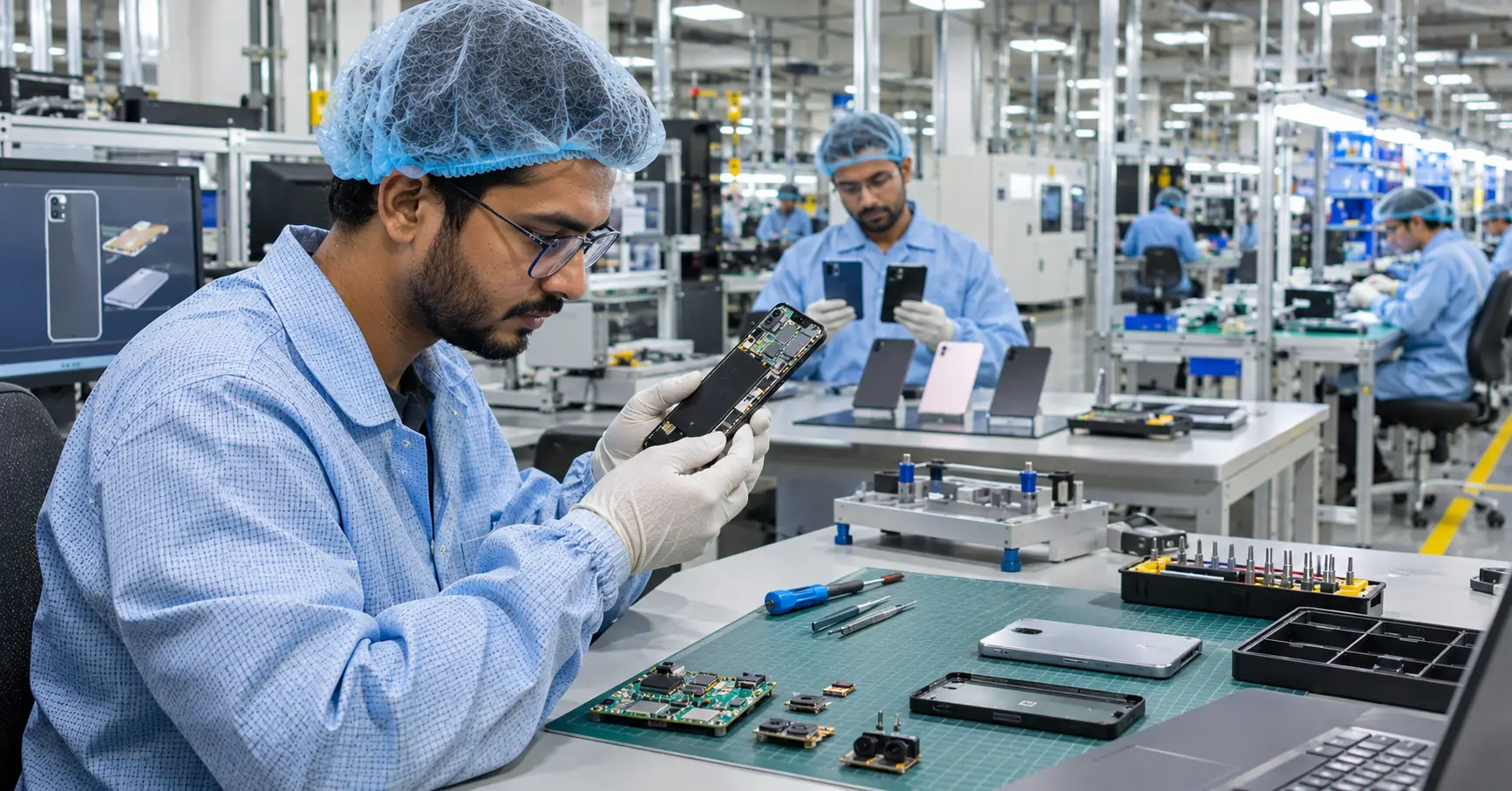
India's smartphone industry has moved well beyond basic handset assembly. The country has developed significant mobile manufacturing and export capacity, while the next stage is increasingly focused on domestic value addition, product design, intellectual property and Indian-owned technology brands.
The Mobile Phone Manufacturing Scheme (MPMS) is designed to support this next phase. Notified in August 2026 with a budgetary outlay of ₹62,500 crore, the scheme runs from FY2026–27 to FY2030–31 and has a dedicated Target Segment 2 for supporting Indian mobile phone brands.
For businesses considering an Indian smartphone brand, this changes the conversation. Building a competitive handset company is no longer only about manufacturing at scale. It increasingly involves product strategy, design, R&D, intellectual property, supply-chain development and the ability to take a product from concept to commercial production.
What Is MPMS and Why Does It Matter for Indian Smartphone Brands?
MPMS was introduced after the Production Linked Incentive Scheme for Large Scale Electronics Manufacturing (PLI-LSEM), whose tenure ended on 31 March 2026. The new scheme aims to increase global competitiveness, deepen domestic value addition, strengthen the mobile manufacturing supply chain and support Indian mobile phone brands.
The scheme has two target segments:
- TS1: Incentivising mobile phone manufacturing
- TS2: Supporting Indian mobile phone brands
For Indian brands, TS2 is particularly important because it goes beyond manufacturing volume. It links support to Indian ownership, domestic design and R&D capabilities and the development of Indian intellectual property.
MPMS provides a 5% incentive for eligible Indian brands and an additional 3% incentive for eligible Indian design and R&D. It also provides non-fiscal support for Indian brands.
Who Can Qualify as an Indian Brand Under MPMS?
This is an important distinction for businesses considering the scheme. MPMS does not mean that every new Indian smartphone startup automatically qualifies for Target Segment 2.
Eligibility for TS2 requires the applicant to be a mobile phone manufacturer, including an India-registered EMS company, with a minimum turnover of ₹1,000 crore in FY2025–26.
The applicant must also satisfy the scheme's definition of an Indian Brand. The notified criteria include:
- Registration or incorporation in India
- Intellectual property and trademark held within India
- Management control with Indian citizens
- More than 51% shareholding held by Indian citizens
- In-house R&D and design capabilities in India
This makes MPMS particularly relevant to established Indian electronics businesses and brands that have the scale and infrastructure required to build a complete product ecosystem.
Why Design and R&D Matter in the AI Smartphone Era
Smartphones are increasingly differentiated by software, cameras, processors, connectivity and AI capabilities rather than hardware specifications alone.
AI-enabled handsets can use on-device processing for features such as image enhancement, voice functions, translation, summarisation, personalisation and other intelligent experiences. This increases the importance of the relationship between product design, hardware selection, software and manufacturing.
For an Indian smartphone brand, developing these capabilities domestically can create greater control over:
- Product specifications and industrial design
- Hardware and software integration
- Camera and imaging experiences
- AI-enabled product features
- Power and thermal management
- User experience and localisation
- Product intellectual property
MPMS therefore creates a policy environment where Indian ownership and domestic design and R&D are directly connected to the development of mobile brands.
From Smartphone Concept to Commercial Product
Building a smartphone brand requires coordination across several stages. The process can begin with market research and product positioning before moving into industrial design, hardware architecture and engineering.
A typical development journey can include:
- Market and consumer research
- Product definition and specification
- Industrial and mechanical design
- Hardware and PCB development
- Software and firmware integration
- Prototype development and validation
- Testing and reliability evaluation
- Manufacturing process development
- Pilot production
- Mass production and quality control
The closer these functions are coordinated, the easier it can be to move from a product concept to a manufacturable commercial device.
Why Manufacturing Capability Still Matters
Design and R&D alone do not create a successful smartphone brand. The product must also be manufactured consistently, tested thoroughly and scaled economically.
Modern smartphone production can involve PCB assembly, component placement, manual insertion, final assembly, testing and packaging. Manufacturing partners also need systems for quality control, material management and production scalability.
Optiemus Electronics Limited (OEL) currently provides Electronics Manufacturing Services across mobile devices, telecom products, IT hardware and hearables and wearables. Its manufacturing capabilities include Surface Mount Technology (SMT), Manual Insertion (MI) and Final Assembly, Testing & Packaging (FATP).
Explore Optiemus' electronics manufacturing capabilities.
Domestic Sourcing Is Another Part of the MPMS Opportunity
MPMS also creates an incentive for domestic sourcing. An additional incentive of up to 1.5% is available for qualifying domestic sourcing of key components and sub-assemblies under the scheme, subject to the prescribed conditions, including localisation for at least 25% of the total mobile phone units manufactured during a financial year.
This is important because smartphone manufacturing is part of a much larger ecosystem. Components such as displays, camera modules, PCBs, batteries, connectors, mechanical parts and other sub-assemblies influence both product cost and supply-chain resilience.
For Indian brands, developing relationships with capable domestic suppliers can therefore become part of a broader manufacturing strategy rather than simply a compliance exercise.
How an EMS Partner Can Support an Indian Smartphone Brand
An EMS partner can play an important role in converting a product design into a scalable manufacturing programme.
Depending on the engagement, this can include:
- Manufacturing process development
- PCB assembly and electronics production
- Prototype and pilot-build support
- Final assembly and testing
- Production ramp-up
- Quality control and inspection
- Material and supplier coordination
- Mass-production support
The objective is to create a bridge between the brand's engineering and product teams and the physical manufacturing environment.
Optiemus' Experience Across the Mobile Ecosystem
Optiemus Infracom has operated in India's mobile and telecommunications ecosystem for more than three decades. Its history includes mobile distribution, consumer technology brands and manufacturing activities.
The company has previously developed and marketed Indian mobile brands including Zen and Kult, while its website also documents the BlackBerry Evolve smartphone as a device conceptualised, designed and manufactured in India.
These experiences illustrate the different layers involved in building a mobile brand: understanding the market, defining the product, working with technology and manufacturing partners, and bringing the finished device to consumers.
Explore Optiemus' mobile and consumer electronics brand portfolio.
What Indian Smartphone Brands Need to Build for the AI Era
The next generation of Indian smartphone brands will need to compete on more than price.
AI-enabled smartphones require careful coordination between processing hardware, memory, cameras, sensors, connectivity, battery systems, thermal design and software.
For a brand, this means building capabilities across four connected areas:
Product
A clear product proposition, industrial design and user experience that gives consumers a reason to choose the brand.
Technology
Domestic design and R&D capabilities that can support hardware, software and AI-enabled features.
Manufacturing
A scalable production ecosystem capable of converting engineering designs into consistent commercial products.
Supply Chain
Reliable access to components, sub-assemblies and qualified suppliers, with opportunities to increase domestic value addition over time.
MPMS Is About More Than Manufacturing Incentives
The strategic importance of MPMS lies in its broader approach to the mobile ecosystem.
Its support for Indian brands, domestic design and R&D, component sourcing and manufacturing is intended to encourage greater value creation within India.
For qualifying companies, this can create an opportunity to build an Indian-owned smartphone business with stronger control over product development and a deeper connection between design, intellectual property and manufacturing.
At the same time, the eligibility thresholds mean that businesses should assess their scale, ownership structure, R&D capabilities and manufacturing model carefully before assuming that they qualify for TS2.
Conclusion
Building an Indian smartphone brand in the AI era requires much more than establishing a production line. Successful brands need a combination of product strategy, domestic design and R&D, intellectual property, manufacturing capability and a resilient component ecosystem.
MPMS creates a policy framework specifically aimed at strengthening these capabilities. Its Target Segment 2 provides support for eligible Indian mobile brands, including incentives for Indian design and R&D and additional support linked to qualifying domestic sourcing.
Optiemus brings experience across mobile brands, electronics manufacturing and the wider telecommunications ecosystem. Through OEL's manufacturing capabilities, the group can support the manufacturing side of the journey from electronics production through final assembly, testing and packaging.
For Indian companies building the next generation of smartphones, the opportunity is to move beyond simply making phones in India and build more of the product, technology, intellectual property and value chain in India.
Learn more about Optiemus and its technology ecosystem.
Frequently Asked Questions
What is MPMS?
The Mobile Phone Manufacturing Scheme is a Government of India scheme for FY2026–27 to FY2030–31 designed to increase mobile manufacturing competitiveness, deepen domestic value addition, strengthen supply chains and support Indian mobile phone brands.
What is Target Segment 2 of MPMS?
Target Segment 2 is the part of MPMS focused on supporting eligible Indian mobile phone brands. It provides a 5% incentive for Indian brands, with an additional 3% incentive for eligible Indian design and R&D, along with non-fiscal support.
Can every Indian smartphone startup apply under MPMS?
No. TS2 has specific eligibility requirements, including a minimum applicant turnover of ₹1,000 crore in FY2025–26 and conditions relating to Indian ownership, management control, intellectual property, trademark and in-house R&D and design capabilities.
What is the additional domestic sourcing incentive under MPMS?
MPMS provides an additional incentive of up to 1.5% for qualifying domestic sourcing of key components and sub-assemblies, subject to the scheme's prescribed conditions.
Why is R&D important for an Indian smartphone brand?
Domestic R&D can give a brand greater control over product design, hardware and software integration, intellectual property and differentiated features, including AI-enabled smartphone experiences.
