

India is steadily strengthening its position in the global electronics value chain. The opportunity is no longer limited to assembling finished products. Manufacturers are increasingly expected to build deeper local supply chains, maintain consistent quality and support complex products at commercial scale.
This shift is particularly important for telecom and IT hardware. Network equipment, computing devices and other connected hardware need reliable components, controlled manufacturing processes and rigorous testing before they can enter demanding business and infrastructure environments.
For businesses evaluating telecom equipment manufacturing in India, the real question is therefore not simply whether a facility can manufacture a product. It is whether the manufacturing ecosystem behind that facility has the localisation, quality systems, testing capabilities and supply-chain depth required to deliver consistently.
Why Telecom and IT Hardware Manufacturing Matters
Telecom and IT hardware form part of the infrastructure that keeps businesses, institutions and digital services connected.
Telecom equipment supports connectivity and network infrastructure, while IT hardware provides the computing and processing capabilities required by enterprises and other organisations.
As India's digital infrastructure expands, the manufacturing requirements around this equipment are becoming more sophisticated. Customers increasingly need products that can be manufactured reliably at scale while meeting defined performance and quality requirements.
This is creating opportunities for telecom equipment manufacturers in India that can combine production capabilities with engineering, testing and supply-chain management.
What Is Telecom and IT Hardware Manufacturing?
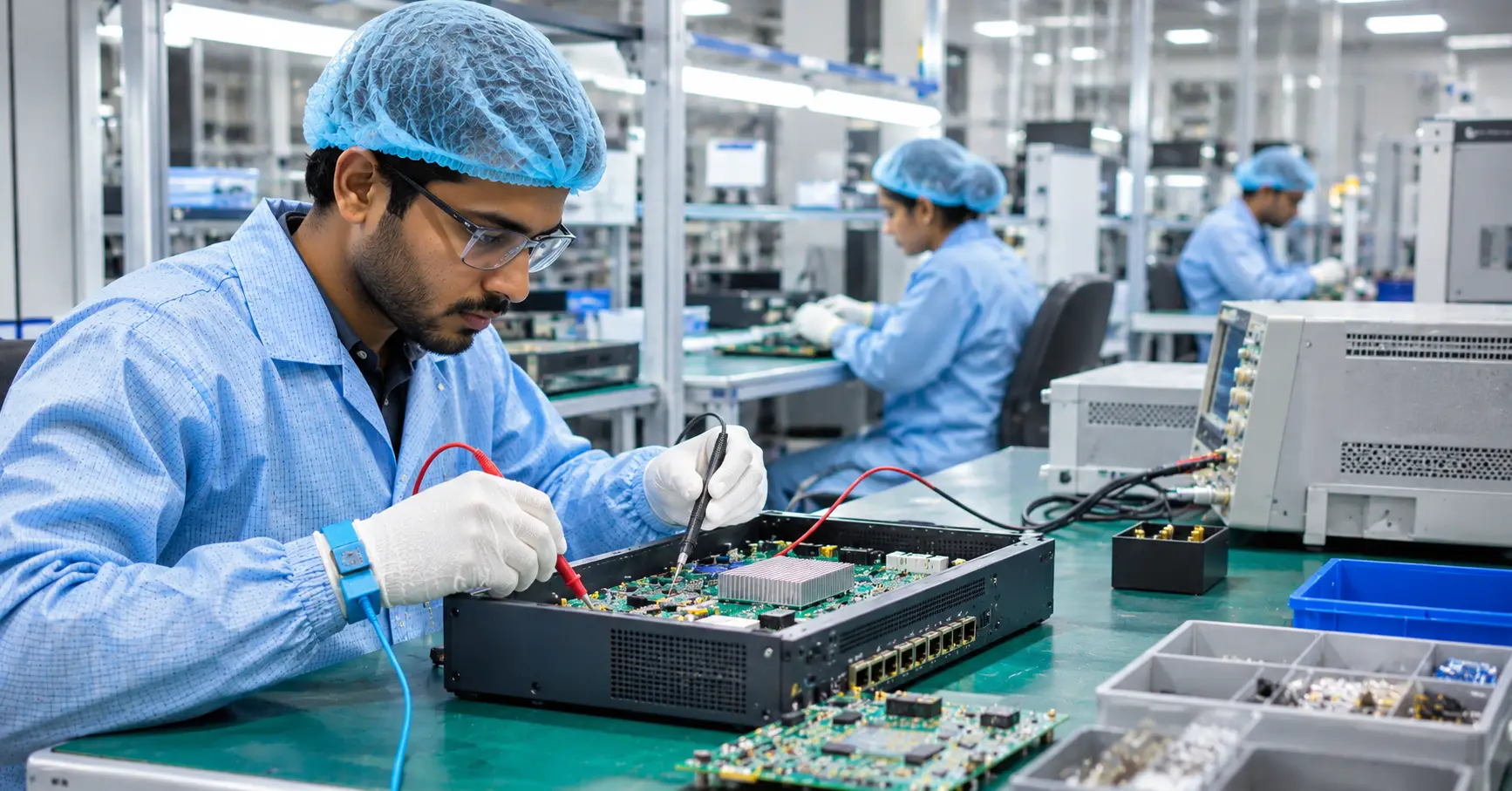
Telecom and IT hardware manufacturing involves the production and assembly of electronic equipment used across communication, networking and computing environments.
The exact products vary by manufacturer and application, but the broader manufacturing process can involve:
- Component sourcing and incoming inspection
- Printed circuit board assembly
- Surface Mount Technology (SMT)
- Manual insertion and component assembly
- Mechanical assembly
- Firmware or software loading where applicable
- Functional and reliability testing
- Final assembly and packaging
The complexity increases when products have strict performance, reliability or environmental requirements. That is why the manufacturing facility itself is only one part of the equation. The supporting quality and supply-chain infrastructure matters just as much.
Localisation: More Than Just Manufacturing in India
One of the biggest changes in India's electronics industry is the increasing focus on localisation.
Manufacturing a product in India does not necessarily mean that the complete value chain is located in India. A facility may assemble a finished product domestically while relying heavily on imported components and sub-assemblies.
Deeper localisation means gradually building more of that ecosystem within the country.
This can include local sourcing of components, development of domestic suppliers, local engineering support, testing infrastructure and manufacturing processes.
Why Does Localisation Matter?
Localisation can provide several strategic advantages:
- Supply-chain resilience: A broader domestic supplier ecosystem can reduce exposure to international disruptions.
- Faster response: Local suppliers can potentially shorten replenishment and development cycles.
- Cost optimisation: Greater scale and supplier competition can improve manufacturing economics over time.
- Value addition: More stages of the product lifecycle can take place within India.
- Product development: Closer coordination between engineering, suppliers and manufacturers can support faster iteration.
Localisation does not happen overnight. It requires investment, supplier development, consistent volumes and a manufacturing ecosystem capable of supporting the transition.
Quality Testing Is Central to Telecom Hardware
For telecom and IT products, quality cannot be treated as a final checkpoint alone.
A hardware failure in a consumer device may inconvenience one user. A failure in network or enterprise equipment can have a much wider operational impact.
That makes quality management important throughout the manufacturing process.
Testing can take place at multiple stages, including incoming materials, PCB assemblies, sub-assemblies and completed products.
Incoming Quality Control
Incoming Quality Control (IQC) helps manufacturers assess components and materials before they enter production.
This matters because a defective or inconsistent component can create problems further down the manufacturing line. Identifying those issues early can reduce rework, production delays and downstream failures.
Functional Testing
Functional testing verifies whether the finished or partially assembled product performs according to its defined requirements.
Depending on the hardware, testing can cover areas such as electrical performance, connectivity, interfaces, power systems, communication functions and other product-specific parameters.
Reliability Testing
Reliability testing focuses on how products perform under defined conditions over time or when exposed to relevant stresses.
For telecom and IT hardware, reliability can be especially important because equipment may operate continuously and in environments where access for repair or replacement is not always simple.
A strong manufacturing operation therefore needs more than assembly lines. It needs appropriate inspection, testing and quality infrastructure around those lines.
Supply Chain Depth: The Hidden Advantage
A manufacturing facility can have impressive production capacity and still face challenges if its supply chain is fragile.
Supply-chain depth refers to the strength and breadth of the ecosystem supporting manufacturing. This includes component suppliers, sub-assembly providers, logistics partners, engineering teams, quality systems and alternative sourcing options.
For telecom equipment manufacturing companies in India, this becomes increasingly important as products become more sophisticated.
A deeper supply chain can help manufacturers:
- Reduce dependence on individual suppliers
- Respond more effectively to demand changes
- Improve material availability
- Support product localisation
- Manage product revisions more efficiently
- Build greater resilience against external disruptions
The strongest manufacturing ecosystems therefore do not operate as isolated factories. They function as connected networks of suppliers, engineers, production teams and quality systems.
Why 5G Is Raising the Manufacturing Bar
The expansion of 5G networks is also increasing the importance of capable telecom hardware manufacturing.
Modern network infrastructure requires equipment that can meet demanding requirements around performance, connectivity, thermal management, reliability and interoperability.
As a result, manufacturers supporting the telecom ecosystem need processes capable of handling increasingly sophisticated electronic assemblies.
This creates opportunities for Indian manufacturers that can combine local production with appropriate engineering and testing infrastructure.
However, being a 5G telecom equipment manufacturer in India is not simply about assembling hardware. Product-specific technical requirements, testing protocols, certifications and customer specifications all need to be addressed according to the equipment being manufactured.
IT Hardware Manufacturing Requires Similar Depth
The same principles apply to IT hardware.
Computing and networking products require precise electronic assembly, mechanical integration, testing and quality control. Customers may also require consistent production across large volumes and multiple product configurations.
For IT hardware manufacturers in India, manufacturing competitiveness therefore depends on more than labour availability or production capacity.
It depends on the ability to integrate:
- Component sourcing
- Automated and semi-automated assembly
- Engineering and process control
- Inspection and testing
- Quality management
- Production planning
- Supply-chain coordination
This integrated approach becomes particularly valuable for brands that need to scale products without compromising consistency.
Optiemus and India's Telecom & IT Hardware Manufacturing Ecosystem
Optiemus has built manufacturing capabilities across multiple electronics categories through its subsidiaries and manufacturing facilities.
Its Global Devices Network (GDN) is a dedicated manufacturing facility covering more than 55,000 sq. ft. of production area. The facility has 16 assembly lines along with dedicated areas for Incoming Quality Control (IQC) and a Reliability Lab equipped with testing machines.
GDN was awarded the Production Linked Incentive (PLI) for manufacturing IT hardware, telecom and networking products in 2021.
Optiemus Electronics Limited (OEL) also manufactures telecom products and IT hardware alongside mobile devices and hearables and wearables. OEL provides Electronics Manufacturing Services including SMT, Manual Insertion and Final Assembly, Testing & Packaging (FATP), supported by 40 production lines.
This gives the Optiemus group capabilities across multiple stages of electronics manufacturing rather than limiting its operations to a single product category.
Explore Optiemus' telecom and IT hardware manufacturing capabilities.
What Should Businesses Look for in a Manufacturing Partner?
When selecting a telecom or IT hardware manufacturing partner, production capacity is only one consideration.
Businesses should evaluate the complete manufacturing ecosystem.
1. Manufacturing Capacity
Can the facility support the required production volume today and scale as demand increases?
2. Quality Infrastructure
Does the manufacturer have appropriate incoming inspection, in-process quality controls, functional testing and reliability capabilities?
3. Supply-Chain Strength
Does the manufacturer have access to reliable suppliers and the ability to manage component availability and sourcing risks?
4. Localisation Capability
Can the manufacturer support increasing domestic sourcing and supplier development as localisation requirements evolve?
5. Engineering Support
Can the manufacturing partner manage design changes, process optimisation and production engineering when required?
6. Track Record
Has the manufacturer successfully produced similar electronics products at commercial scale?
These factors provide a much more useful picture of manufacturing capability than production capacity alone.
The Shift from Factory Capacity to Manufacturing Ecosystems
India's electronics manufacturing opportunity is expanding beyond production scale, with growing emphasis on local sourcing, advanced manufacturing processes, product quality and stronger domestic supply chains.
Earlier, the primary objective was to establish production capacity and attract global manufacturing into the country. The next stage is about building an ecosystem that can support the complete product lifecycle.
That means stronger suppliers, deeper localisation, better testing infrastructure, skilled engineering teams and resilient logistics networks.
For telecom and IT hardware, this shift is particularly important because customers often require consistency and reliability over long production cycles.
The manufacturers that can connect these capabilities will be better positioned to serve both Indian and international customers.
Conclusion
Telecom equipment manufacturing in India is evolving beyond basic assembly. Localisation, quality testing and supply-chain depth are becoming central to the competitiveness of Indian manufacturing.
For telecom and IT hardware companies, a capable manufacturing partner should therefore bring together production capacity, quality systems, testing infrastructure, supplier relationships and engineering expertise.
Optiemus Electronics Limited (OEL) supports this manufacturing ecosystem through its capabilities across telecom and IT hardware, with infrastructure designed to support production, testing and quality requirements.
India's growing electronics ecosystem provides the foundation for this transition. The opportunity now is to deepen it by moving from manufacturing products in India toward building more of the technology value chain in India.
For businesses evaluating manufacturing partners, the right facility is not simply the one with the most assembly lines. It is the one with the infrastructure, processes and ecosystem required to manufacture reliably, scale efficiently and build for the long term.
