

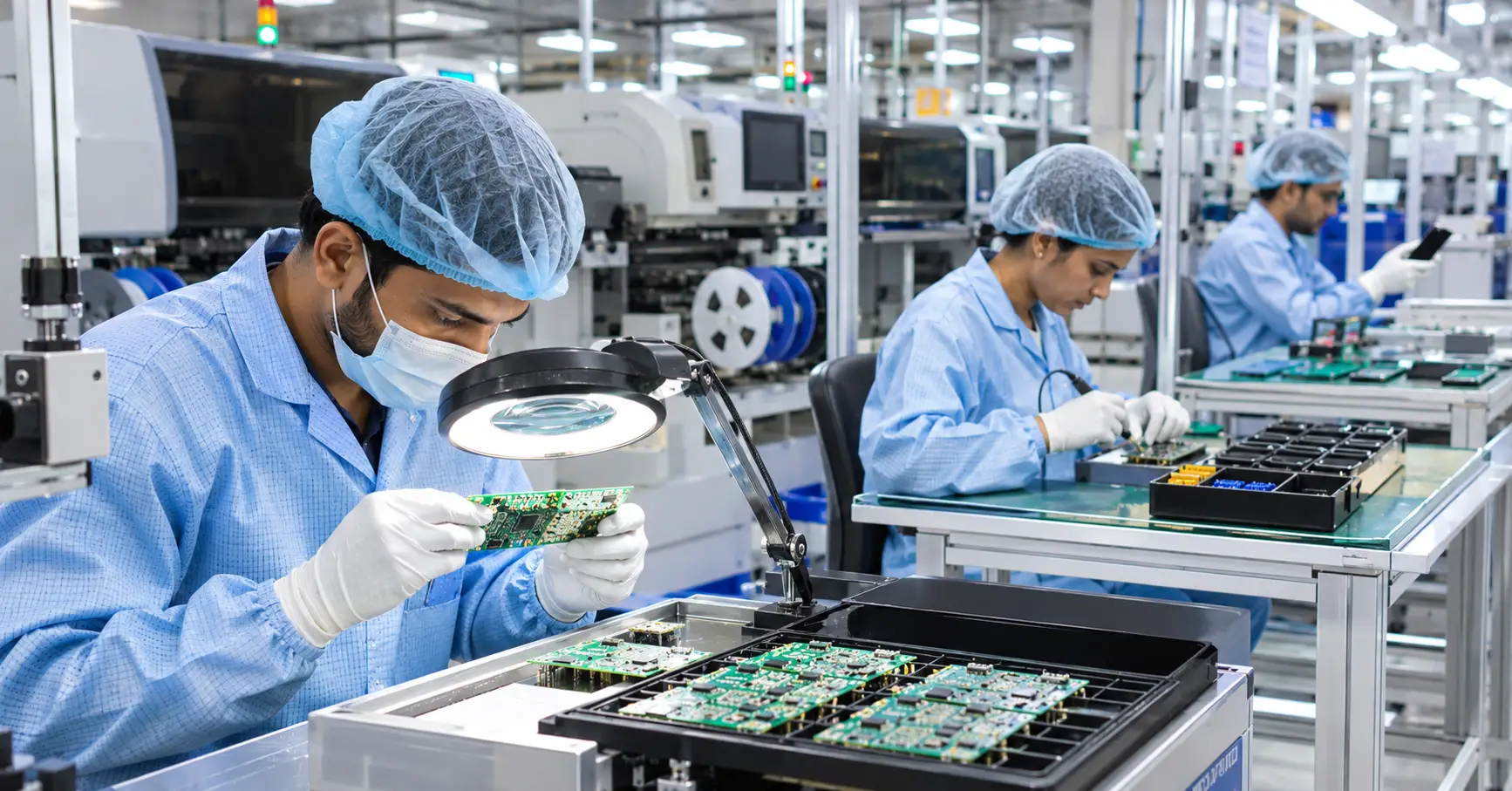
A modern smartphone may look like a single finished product, but it is the result of multiple manufacturing, assembly and quality-control processes working together.
From mounting tiny electronic components onto a printed circuit board to assembling, testing and packaging the finished device, mobile phone manufacturing requires precision and coordination at every stage.
Three important stages in an Electronics Manufacturing Services (EMS) facility are Surface Mount Technology (SMT), Manual Insertion (MI) and Final Assembly, Testing & Packaging (FATP).
Understanding these processes helps brands evaluate what an EMS partner can deliver beyond basic assembly.
What Happens Inside a Mobile Phone Manufacturing Facility?
Mobile phone production transforms individual electronic components and mechanical parts into a tested, finished device.
At a high level, the process involves:
- Preparing electronic components and materials
- Mounting components onto printed circuit boards
- Adding components through manual or specialised processes where required
- Inspecting and testing assemblies
- Integrating electronic and mechanical sub-assemblies
- Testing the completed handset
- Packaging the finished product
What Is SMT in Mobile Phone Manufacturing?
SMT stands for Surface Mount Technology. It is a process used to mount electronic components directly onto the surface of a printed circuit board (PCB).
The process generally starts with applying solder paste to specific locations on the PCB. Automated equipment then places components such as resistors, capacitors and integrated circuits onto the board. The populated PCB passes through a reflow process, where controlled heat melts the solder paste and creates permanent connections.
SMT is particularly important for smartphones because modern devices require compact, high-density electronic assemblies.
It enables manufacturers to:
- Place small components accurately
- Maintain consistent component placement
- Support high-volume production
- Enable compact PCB designs
- Improve manufacturing repeatability
What Is Manual Insertion (MI)?
Not every component is suitable for automated surface mounting. Manual Insertion (MI) is used for components or processes that require controlled human handling.
These may include components with unusual dimensions, mechanical characteristics or other product-specific requirements that make conventional automated placement unsuitable.
Manual insertion does not mean the manufacturing process is largely manual. In a modern EMS facility, it is one controlled stage within a broader combination of automation, skilled operators, inspection and quality processes.
What Is FATP?
FATP stands for Final Assembly, Testing & Packaging. This is where electronic and mechanical sub-assemblies come together to form the finished product.
Depending on the handset design, final assembly can include integrating the PCB, display, battery, cameras, speakers, microphones, connectors and housing.
After assembly, the device goes through appropriate testing and quality checks before being packaged for distribution.
Why Testing Matters in Mobile Phone Manufacturing
A smartphone can appear physically complete while still having an electrical, mechanical or functional problem. Testing therefore takes place at different stages of production rather than only after final assembly.
Depending on the product and customer requirements, testing can cover:
- PCB and component performance
- Electrical connectivity
- Display and camera functionality
- Audio and charging functions
- Buttons, sensors and connectivity
- Physical and cosmetic quality
Testing requirements vary by product, which makes inspection and testing infrastructure an important factor when selecting an EMS partner.
How SMT, Manual Insertion and FATP Work Together
These processes are connected stages of the electronics manufacturing workflow.
| Stage | Primary Purpose | Output |
|---|---|---|
| SMT | Mount electronic components onto PCBs | Populated PCB assembly |
| Manual Insertion | Handle components requiring manual intervention | Further-completed electronic assembly |
| FATP | Complete assembly, testing and packaging | Finished, tested device |
The effectiveness of the overall manufacturing process depends on how well these stages work together.
Why Process Integration Matters for EMS Companies
For brands outsourcing production, an EMS partner needs to provide more than assembly capacity. The manufacturer should be able to coordinate production, quality control, engineering and testing across multiple stages.
A problem during PCB assembly can affect final assembly, while inadequate testing can allow defects to progress further through the production line. Integrated processes create clearer quality checkpoints and better production control.
What Does an Indian EMS Facility Need to Deliver?
As mobile phone manufacturing in India continues to grow, EMS facilities need to combine production capacity with process discipline and quality management.
Modern manufacturing operations may include automated production equipment, inspection systems, testing infrastructure, material handling and trained quality teams. Production planning, engineering support and supplier coordination are equally important for maintaining consistency at scale.
How OEL's Capabilities Fit Into the Manufacturing Process
Optiemus Electronics Limited (OEL) provides Electronics Manufacturing Services across multiple product categories, including mobile devices. Its manufacturing capabilities include Surface Mount Technology (SMT), Manual Insertion (MI) and Final Assembly, Testing & Packaging (FATP).
These capabilities directly correspond to the manufacturing stages explained in this article. SMT supports electronic assembly, Manual Insertion handles components requiring controlled manual intervention, and FATP brings the product together through final assembly, testing and packaging.
For brands evaluating an EMS partner, having these capabilities within an integrated manufacturing operation can help coordinate production stages while maintaining quality and process control.
Explore Optiemus' electronics manufacturing capabilities.
Why India's EMS Ecosystem Is Becoming More Important
India's electronics manufacturing industry has developed significantly, with mobile devices playing an important role in that transformation. Government initiatives, domestic demand and global supply-chain diversification are supporting continued growth.
This creates opportunities for both global and Indian brands seeking manufacturing partners within the country.
For an EMS provider, the ability to support a product from electronic assembly through final assembly and testing can reduce manufacturing complexity and make scaling more efficient.
What Should Brands Look for in an EMS Partner?
Brands evaluating a mobile manufacturing partner should look beyond production capacity and consider:
- SMT and PCB assembly capabilities
- Manual insertion capabilities where required
- FATP and final assembly infrastructure
- Inspection and testing systems
- Production scalability
- Quality-control processes
- Engineering and process support
- Supply-chain coordination
These factors help distinguish between basic assembly capacity and an integrated manufacturing partner.
Conclusion
SMT, Manual Insertion and FATP represent three important stages in the mobile phone assembly journey.
SMT builds the electronic foundation, Manual Insertion supports components requiring controlled manual handling, and FATP brings the product together through final assembly, testing and packaging.
For brands evaluating electronics manufacturing services in India, the right partner is not simply one with assembly lines. It is one with the processes, infrastructure, engineering capabilities and quality systems required to manufacture consistently at scale.
Optiemus Electronics Limited (OIL) brings these capabilities together through its electronics manufacturing infrastructure, supporting mobile and other electronic products across key stages of the manufacturing process.
As India's electronics ecosystem continues to mature, integrated EMS capabilities will become increasingly important in helping brands develop and scale products from India.
