

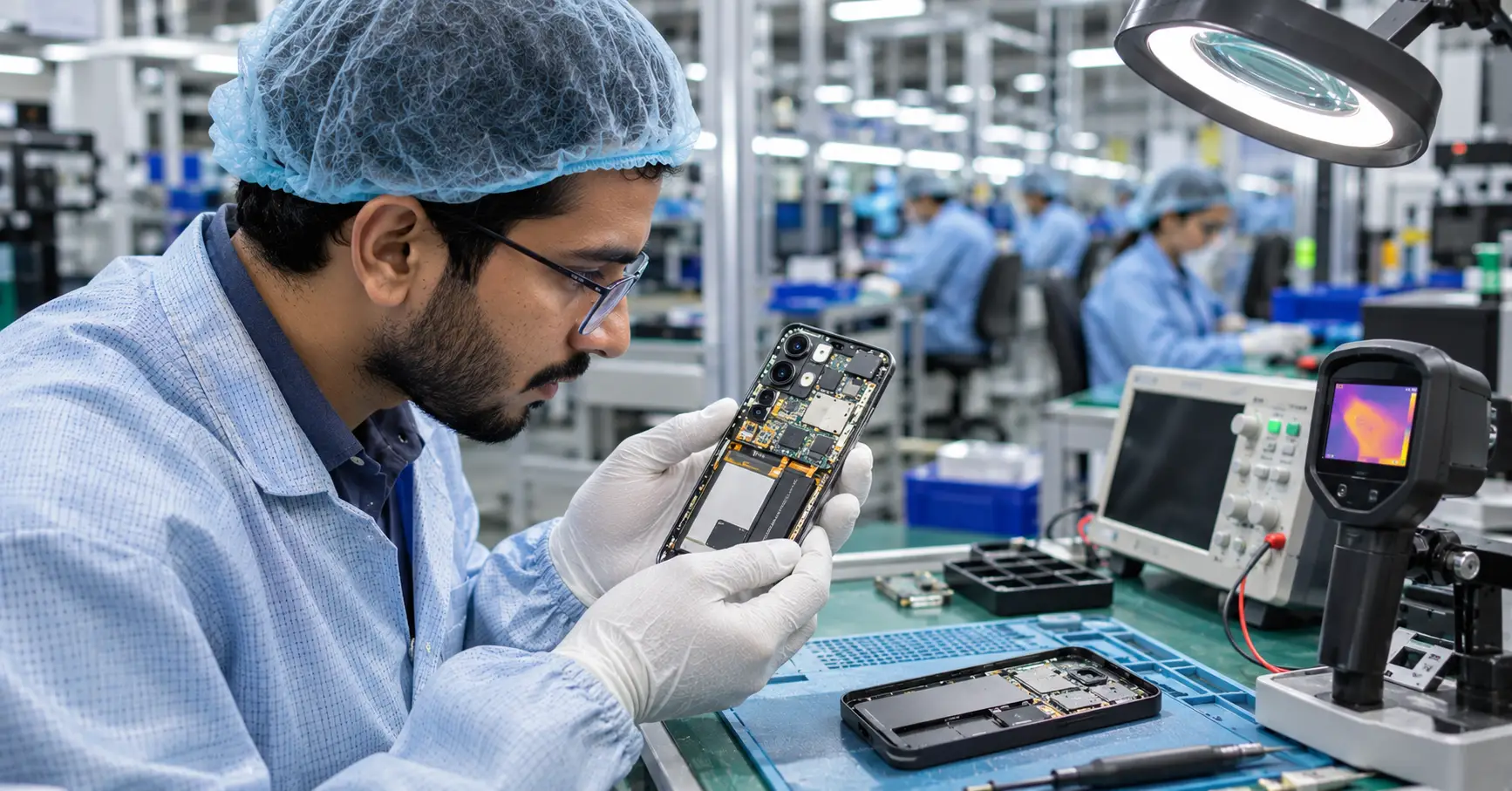
Artificial intelligence is reshaping how people use their smartphones, making everyday tasks faster, more intuitive and increasingly personalised. Features such as AI-powered photography, voice assistance, translation, summarisation, content creation and personalisation are moving from standalone applications into the core smartphone experience.
But delivering these experiences is not simply a matter of adding an AI feature to an existing phone. When AI processing happens directly on the smartphone, the hardware itself has to be designed to support it.
That changes what manufacturers need to consider, from the processor and memory architecture to thermal management, battery performance, software integration, testing and supply-chain planning.
For AI smartphone manufacturing in India, this creates a new opportunity for manufacturers and Electronics Manufacturing Services (EMS) providers that can support increasingly sophisticated handset architectures.
What Is On-Device AI?
On-device AI refers to artificial intelligence processing that takes place directly on a smartphone rather than relying entirely on remote cloud servers.
A conventional cloud-based AI workflow may send information from the device to a remote data centre for processing before returning the result. On-device processing moves some of that computation onto the smartphone itself.
This can provide several advantages:
- Lower latency: Processing can happen locally without waiting for a round trip to a server.
- Greater privacy: Some information can be processed without leaving the device.
- Offline functionality: Certain AI features can continue working without a continuous internet connection.
- More responsive experiences: Local processing can support faster interactions for suitable workloads.
- Reduced dependence on connectivity: AI functionality does not always have to rely on network availability.
However, moving computation onto a smartphone creates another challenge: the device has to perform more sophisticated processing within strict limits on power, heat, size and cost.
Why AI Is Becoming Important in India's Smartphone Market
As smartphone users in India look beyond basic performance and camera quality, AI features are emerging as an increasingly important factor in how they evaluate and choose their next device.
A 2026 report from Flipkart and Counterpoint Research found that 89% of users said AI features influence their smartphone purchase decisions. The report also highlighted the growing adoption of GenAI-enabled devices and the increasing importance of integrated AI experiences.
This matters for manufacturers because consumer expectations influence product design. AI is moving from being a premium differentiator toward becoming a feature that smartphone buyers increasingly expect across price segments.
For manufacturers, that means the question is no longer simply how to assemble a smartphone. It is how to manufacture devices capable of delivering increasingly demanding AI workloads while maintaining performance, battery life, reliability and cost competitiveness.
What Makes a Smartphone AI-Ready?
An AI-ready smartphone is not defined by a single component. It is a combination of hardware, software and system-level optimisation.
Several hardware elements become particularly important.
1. AI-Capable Processors and NPUs
The processor is at the centre of an AI-capable smartphone.
Modern mobile platforms increasingly include specialised processing capabilities such as a Neural Processing Unit (NPU) or equivalent AI acceleration hardware. These processors are designed to handle specific machine-learning workloads more efficiently than relying exclusively on the CPU.
This can allow smartphones to perform tasks such as image enhancement, speech processing, object recognition and generative AI workloads while using less power than a general-purpose processor might require for the same task.
For manufacturers, integrating these platforms means production processes must accommodate increasingly sophisticated chipsets and supporting components.
2. More Memory and Faster Data Movement
AI workloads can place additional demands on memory.
Large models and AI-enabled applications can require significant memory capacity and fast movement of data between the processor, memory and storage.
That makes memory selection and board design increasingly important during product development.
Counterpoint has noted that the growing adoption of AI-enabled applications and on-device intelligence contributed to higher average smartphone DRAM requirements in 2025.
For manufacturers, this means that AI-ready handsets can require careful planning around memory components, PCB design and component sourcing.
3. Thermal Management
More processing can mean more heat.
A smartphone has a very small physical footprint, so manufacturers cannot simply add a large cooling system when processing requirements increase.
Thermal design therefore becomes a system-level consideration. Internal component placement, materials, heat dissipation mechanisms and power management all influence how effectively the device handles sustained workloads.
Manufacturing processes must maintain the required tolerances and assembly consistency because small variations can affect thermal performance and reliability.
4. Battery and Power Efficiency
AI features are useful only if the smartphone can deliver them without creating an unacceptable impact on battery life.
This creates a balancing act between processing performance and power consumption.
Specialised AI hardware can help by performing certain workloads more efficiently, but the overall system still needs to manage CPU, GPU, NPU, display, connectivity and other components.
For manufacturers, battery integration, charging systems, power management and thermal behaviour therefore become increasingly important during testing.
How On-Device AI Changes Smartphone Manufacturing
The arrival of AI does not replace conventional smartphone manufacturing processes. Instead, it increases the importance of precision across those processes.
A typical manufacturing workflow can still involve:
- Surface Mount Technology (SMT)
- Manual Insertion where required
- PCB inspection and testing
- Final Assembly, Testing & Packaging (FATP)
- Functional testing
- Reliability and quality testing
However, the products being assembled can have more complex boards, higher-performance processors, more memory and increasingly sophisticated camera and sensor systems.
This puts greater emphasis on component placement accuracy, process control and testing.
Testing AI-Ready Smartphones Is More Than Testing the Hardware
An AI-capable smartphone must bring together hardware, software, memory, power management and on-device processing to deliver a consistent user experience. Testing therefore needs to go beyond verifying individual components and assess how these elements perform together under real-world usage conditions.
Manufacturers may need to validate areas such as:
- Processor and AI accelerator performance
- Memory and storage behaviour
- Camera and image-processing functions
- Voice and audio processing
- Thermal performance under sustained workloads
- Battery and power consumption
- Connectivity
- Overall device stability
The exact testing requirements depend on the product architecture, customer specifications and intended AI applications.
The broader principle is straightforward: as smartphones become more computationally sophisticated, manufacturing quality systems need to become sophisticated with them.
Supply Chain Requirements Are Changing Too
AI-ready smartphones can place additional demands on the component supply chain.
Manufacturers may need reliable access to advanced application processors, AI accelerators, memory, storage, cameras, sensors, power-management components and other specialised parts.
At the same time, AI-enabled smartphones are not being developed in isolation. The wider electronics industry is also experiencing strong demand for memory and advanced computing components.
This makes supply-chain planning increasingly important.
For an EMS provider, the ability to manage component sourcing, production planning, quality control and inventory becomes an important part of delivering AI-capable products at scale.
Why Indian Manufacturing Capabilities Matter
India already has a large and expanding smartphone manufacturing ecosystem. The next opportunity is to increase the sophistication of the products being manufactured domestically.
That means moving beyond volume and building capabilities that can support increasingly advanced smartphone architectures.
For smartphone manufacturers in India, this can include investment in advanced assembly, testing infrastructure, engineering capabilities, quality systems and supply-chain integration.
For EMS providers, the ability to manufacture different device architectures at scale can become an important competitive advantage as smartphone brands introduce more AI-enabled products.
Optiemus' Role in India's AI-Ready Device Manufacturing
Optiemus Electronics Limited (OEL) operates manufacturing facilities supporting mobile devices, telecom products, IT hardware and hearables and wearables.
Its current manufacturing infrastructure includes three facilities with a combined production area of approximately 390,000 sq. ft. and 40 production lines. OEL provides manufacturing services covering Surface Mount Technology (SMT), Manual Insertion (MI) and Final Assembly, Testing & Packaging (FATP) for global and Indian customers.
Optiemus has also disclosed an agreement between OEL and NxtQuantum Shift Technologies India Private Limited to manufacture Ai+ smartphones and tablets, demonstrating its involvement in the emerging AI-enabled device category.
These capabilities are relevant because AI-ready devices require the same manufacturing foundations as conventional smartphones—but with increasing demands on component integration, testing, thermal performance and overall product reliability.
Explore Optiemus' electronics manufacturing capabilities.
What Should Brands Consider When Choosing an EMS Partner?
As AI becomes more important to smartphone product development, brands should evaluate manufacturing partners on more than production capacity.
Important considerations include:
- Advanced PCB assembly: Can the manufacturer support complex, high-density electronic assemblies?
- Testing infrastructure: Can it test devices under relevant functional and reliability conditions?
- Production scalability: Can the facility move from pilot production to mass manufacturing efficiently?
- Quality management: Are there strong in-process and final quality controls?
- Supply-chain capabilities: Can the manufacturer manage specialised components and changing demand?
- Engineering support: Can it support product changes and manufacturing optimisation?
- Experience with advanced devices: Does the partner understand increasingly complex mobile hardware?
These factors become especially important when AI functionality is part of the product's core value proposition.
AI Is Changing the Smartphone Manufacturing Equation
The shift toward on-device AI is not simply a software trend. It is changing the hardware requirements of smartphones.
AI-capable processors, higher memory requirements, thermal management, power efficiency and more sophisticated testing all influence how an AI-ready handset is designed and manufactured.
For manufacturers, this creates a need for greater precision and stronger integration across production, testing and supply-chain operations.
For Indian manufacturing, it creates an opportunity to move further up the technology value chain. The country already has significant smartphone production capacity. The next step is to support increasingly advanced devices with deeper manufacturing and engineering capabilities.
Conclusion
On-device AI smartphones represent an important evolution in mobile technology. Instead of relying entirely on cloud computing, smartphones can increasingly process AI workloads locally, enabling faster, more private and more responsive experiences.
But these capabilities come with manufacturing implications.
AI-ready handsets need capable processors, sufficient memory, efficient power management, thermal control, precise assembly and comprehensive testing. They also require supply chains capable of supporting increasingly sophisticated components.
For AI smartphone manufacturing in India, this represents both a challenge and an opportunity. Manufacturers and EMS providers that can combine scale with advanced electronics assembly, testing, engineering and supply-chain capabilities will be better positioned for the next generation of mobile devices.
Optiemus Electronics Limited (OEL) brings together electronics manufacturing capabilities and infrastructure that support the production of mobile and other electronic products, helping brands build and scale devices in India.
The smartphone is becoming more than a communication device. As AI moves closer to the device itself, the manufacturing ecosystem behind it has to become smarter too.
Learn more about Optiemus' manufacturing infrastructure and electronics manufacturing services.
