

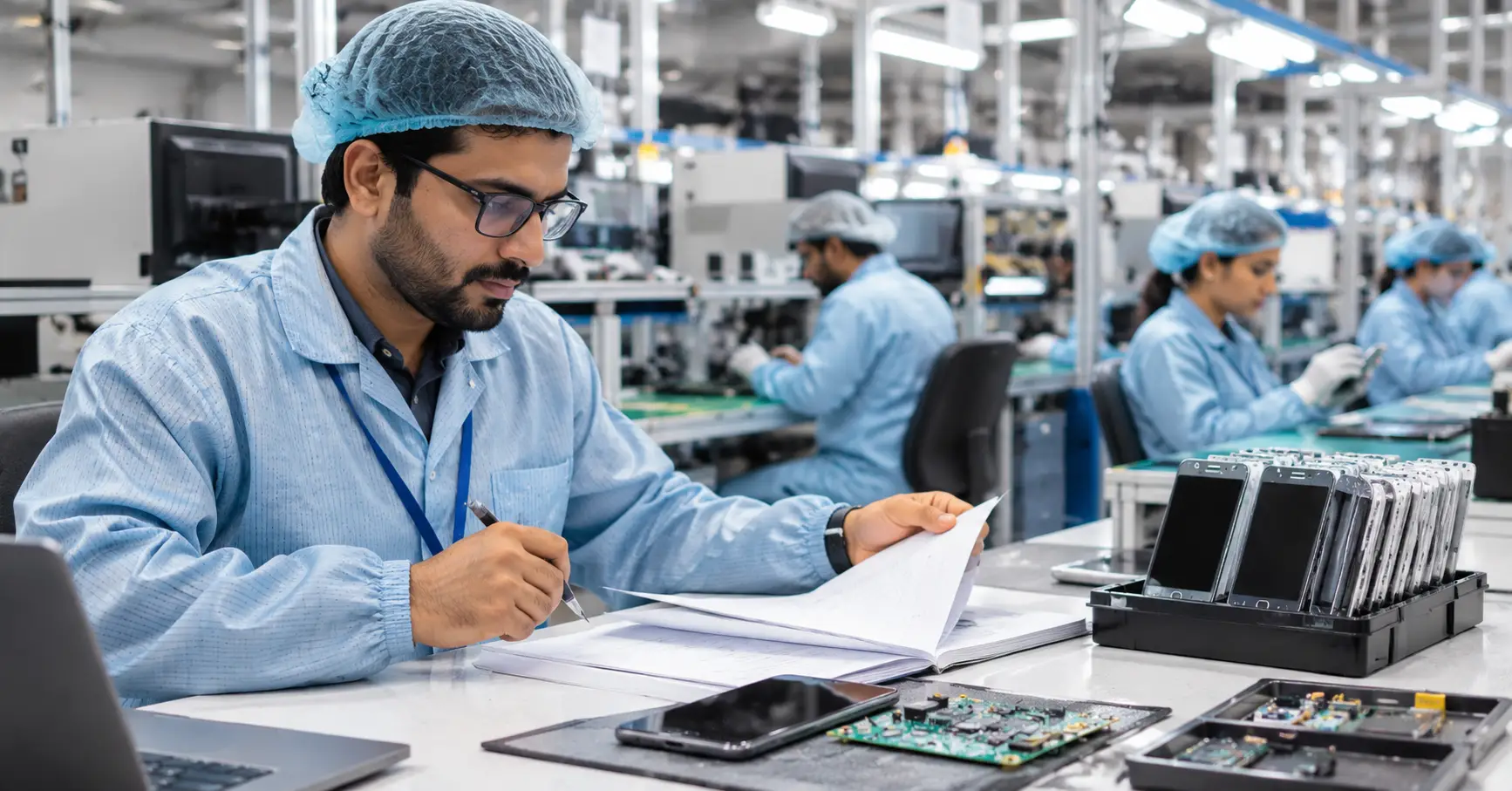
India’s mobile manufacturing ecosystem is entering its next phase. After helping establish the country as a major global manufacturing base, the Production Linked Incentive Scheme for Large Scale Electronics Manufacturing (PLI-LSEM) completed its tenure on 31 March 2026.
To continue that momentum, the Government of India has introduced the Mobile Phone Manufacturing Scheme (MPMS) 2026, with a budgetary outlay of ₹62,500 crore over five years from FY 2026–27 to FY 2030–31.
The new scheme is designed to go beyond simply increasing production. It focuses on deeper domestic value addition, stronger supply chains, greater global competitiveness and the development of Indian mobile brands.
One clarification is important: MPMS is the new scheme succeeding PLI-LSEM for mobile-phone manufacturing. It should not be confused with PLI Scheme 2.0 for IT Hardware, which is a separate government programme. For mobile manufacturers and Electronics Manufacturing Services (EMS) companies, MPMS is the policy framework that matters next.
Why Was PLI-LSEM Replaced?
PLI-LSEM played a major role in changing India’s position in the global mobile manufacturing industry. Introduced in 2020, the scheme was designed to attract investment, increase domestic production, expand exports and encourage large-scale electronics manufacturing.
By the time its tenure ended in March 2026, the scheme had helped establish mobile phones as one of the key drivers of India’s electronics manufacturing growth.
However, the next challenge is different.
India now needs to move from manufacturing at scale toward deeper localisation, stronger domestic supply chains and greater value capture. MPMS has therefore been designed to build on the manufacturing capacity created under PLI-LSEM while placing greater emphasis on domestic value addition and Indian-owned brands.
According to the Government of India, India is now the world’s second-largest mobile phone manufacturer by volume, while 99.2% of mobile phones used in India are manufactured domestically.
What Is the Mobile Phone Manufacturing Scheme (MPMS) 2026?
MPMS is a five-year incentive programme notified by the Ministry of Electronics and Information Technology (MeitY) with a total budgetary outlay of ₹62,500 crore.
The scheme will operate from FY 2026–27 to FY 2030–31 and is intended to increase the scale of mobile phone manufacturing while strengthening the domestic ecosystem around it.
Its objectives include:
- Increasing mobile phone production in India
- Deepening domestic value addition
- Strengthening the mobile manufacturing supply chain
- Improving global competitiveness
- Supporting Indian-owned mobile brands
- Encouraging domestic design and R&D
- Increasing sourcing of key components and sub-assemblies from India
The Government expects the scheme to contribute to approximately ₹39 lakh crore of cumulative mobile phone production during its tenure and generate around 60,000 direct jobs.
How Is MPMS Different from PLI-LSEM?
PLI-LSEM was primarily focused on creating large-scale electronics manufacturing capacity and making India an attractive destination for mobile phone production.
MPMS retains the scale objective but adds a stronger focus on what happens inside that manufacturing ecosystem.
| PLI-LSEM | MPMS |
|---|---|
| Focused on large-scale electronics manufacturing | Focused specifically on mobile phone manufacturing and Indian brands |
| Supported production and investment | Supports production, domestic value addition and supply-chain depth |
| Helped establish India's mobile manufacturing base | Aims to scale and deepen that manufacturing ecosystem |
| Ended on 31 March 2026 | Runs from FY 2026–27 to FY 2030–31 |
| Primarily production-led | Includes additional support for domestic sourcing, Indian brands, design and R&D |
In simple terms, PLI-LSEM helped build the manufacturing engine. MPMS is designed to make that engine more competitive, more localised and capable of capturing more value within India.
What Does MPMS Mean for EMS Companies?
The new scheme is particularly relevant for electronics manufacturing services (EMS) companies in India because EMS providers are explicitly included among eligible mobile phone manufacturers.
Under Target Segment 1, eligible mobile phone manufacturers, including registered EMS companies, can receive incentives linked to eligible sales.
The incentive rate under this segment ranges from 2.25% to 5%, depending on the applicable criteria.
There is also an additional incentive of up to 1.5% for domestic sourcing of eligible key components and sub-assemblies, subject to the scheme's conditions.
This changes the strategic importance of localisation for EMS businesses. Domestic sourcing is no longer simply a supply-chain decision. For eligible companies, deeper localisation can also become connected to the economics of the incentive framework.
MPMS Eligibility: Who Can Apply?
MPMS has two target segments.
Target Segment 1: Mobile Phone Manufacturing
Target Segment 1 focuses on mobile phone manufacturing and includes eligible EMS providers registered in India.
According to the notified scheme, applicants under TS1 must have a minimum turnover of ₹10,000 crore in FY 2025–26.
Existing brands must also meet specified annual sales thresholds over and above their FY 2025–26 sales.
Target Segment 2: Indian Mobile Brands
Target Segment 2 is designed to support Indian-owned mobile brands and has a lower minimum turnover requirement of ₹1,000 crore in FY 2025–26.
However, eligibility also depends on meeting the scheme's definition of an Indian Brand. This includes requirements relating to Indian incorporation, ownership of intellectual property and trademarks in India, management control by Indian citizens, majority Indian shareholding and in-house design and R&D capabilities in India.
This makes TS2 particularly interesting because the policy is not simply rewarding manufacturing volume. It is attempting to encourage Indian ownership of technology, intellectual property, design and brands.
How Do the MPMS Incentives Work?
The incentive structure is divided according to the target segment.
For Target Segment 1, the incentive on eligible sales ranges from 2.25% to 5%.
For Target Segment 2, eligible Indian brands can receive an incentive of 5%, along with an additional 3% incentive linked to eligible design and R&D activity.
Both target segments can also receive an additional incentive of up to 1.5% for domestic sourcing of key components and sub-assemblies, subject to the scheme's localisation conditions.
The result is a policy structure that rewards more than finished-device output. It creates an economic reason for participating companies to strengthen sourcing, design and R&D capabilities within India.
Why Domestic Value Addition Matters
One of the biggest themes behind MPMS is domestic value addition (DVA).
Manufacturing a smartphone in India does not necessarily mean that every major part of its value chain is located in India. Components, sub-assemblies, materials and technologies can still come from international suppliers.
Deepening domestic value addition means gradually increasing the share of the manufacturing ecosystem located within the country.
For EMS companies, this can mean developing stronger relationships with Indian component suppliers, improving local sourcing capabilities and building processes that support higher levels of localisation.
The scheme specifically provides an additional incentive of up to 1.5% for domestic sourcing of key components and sub-assemblies, subject to the requirement that the relevant components are localised for at least 25% of the total mobile phone units manufactured during a financial year.
What This Means for India's Mobile Manufacturing Ecosystem
MPMS arrives at a time when India's mobile manufacturing base is already significantly larger than it was when PLI-LSEM was introduced.
The next stage is therefore less about proving that India can assemble mobile phones at scale and more about building a resilient ecosystem around that manufacturing capacity.
That includes component suppliers, testing infrastructure, engineering capabilities, design, R&D, logistics and supply-chain partners.
For mobile handset manufacturers in India, this creates both an opportunity and a higher bar. Scale remains important, but competitiveness will increasingly depend on how efficiently a company can integrate manufacturing with localisation and product development.
Where EMS Companies Fit Into India's Next Manufacturing Phase
EMS companies are positioned at the centre of this transition because they connect brands with large-scale manufacturing infrastructure.
A capable EMS partner can provide production capacity, process engineering, assembly, testing, quality control and supply-chain integration without requiring every brand to build a complete manufacturing operation from scratch.
Optiemus Electronics Limited (OEL), for example, provides electronics manufacturing services across mobile devices, IT hardware, telecom products and hearables and wearables. Its manufacturing capabilities include Surface Mount Technology (SMT), Manual Insertion (MI), and Final Assembly, Testing & Packaging (FATP).
OEL was also awarded the PLI incentive for mobile phone manufacturing in 2020, giving Optiemus direct experience with the earlier manufacturing incentive framework.
Explore Optiemus' electronics manufacturing capabilities.
What Should EMS Companies Do Now?
MPMS should not be viewed simply as another government incentive. For eligible businesses, it is a reason to reassess their manufacturing strategy for the next five years.
EMS companies should consider:
- Evaluating eligibility: Review turnover, manufacturing status and other applicable criteria.
- Planning localisation: Identify components and sub-assemblies where domestic sourcing can be increased.
- Strengthening manufacturing capacity: Ensure facilities can support the scale and quality requirements of global customers.
- Building supply-chain resilience: Reduce unnecessary dependence on single-source or geographically concentrated suppliers.
- Developing engineering capabilities: Invest in process engineering, quality systems and manufacturing technology.
- Supporting design and R&D: For businesses targeting Indian-brand opportunities, domestic design and R&D capabilities may become increasingly important.
The Bigger Opportunity: From Assembly to a Deeper Electronics Ecosystem
MPMS is ultimately about where India wants its mobile manufacturing industry to go next.
The first phase was about bringing large-scale production into the country. The next phase is about capturing more of the value created around that production.
That means stronger component ecosystems, greater domestic sourcing, Indian intellectual property, local design capabilities and globally competitive manufacturing.
For EMS companies, this could create opportunities to move beyond traditional assembly and become deeper strategic manufacturing partners for global and Indian brands.
Conclusion
The Mobile Phone Manufacturing Scheme (MPMS) 2026 marks the next chapter in India's mobile manufacturing strategy.
PLI-LSEM helped establish India as a major manufacturing destination for mobile phones. MPMS builds on that foundation with a stronger emphasis on domestic value addition, supply-chain resilience, Indian brands, design and R&D.
For EMS companies, the opportunity is significant—but so are the expectations. Scale alone will not define the next generation of electronics manufacturing. Companies that can combine manufacturing capacity with localisation, quality, engineering and supply-chain depth will be better positioned for the next phase of India's electronics growth.
With a five-year framework and a ₹62,500 crore outlay, MPMS gives the industry a clear policy direction. The question now is not whether India can manufacture mobile phones at scale. It is how much more of the value chain India can build, own and compete with globally.
Optiemus Infracom Limited (OIL) is positioned within this evolving manufacturing ecosystem through its subsidiaries. Optiemus Electronics Limited (OEL) manufactures mobile devices and other electronics, while Global Devices Network (GDN), a wholly owned subsidiary of OIL, manufactures IT hardware, telecom and networking products. OEL was awarded the PLI for mobile phone manufacturing in 2020, while GDN was awarded PLI for IT hardware, telecom and networking products in 2021.
With experience across mobile manufacturing, telecom, IT hardware and related electronics, Optiemus reflects the broader transition in India's electronics sector—from building manufacturing capacity to developing deeper and more integrated domestic capabilities.
Learn more about Optiemus' manufacturing infrastructure and electronics manufacturing services.
Explore Optiemus Manufacturing Capabilities
Discover our electronics manufacturing infrastructure, engineering, assembly, testing and supply-chain capabilities.
Explore Manufacturing →