

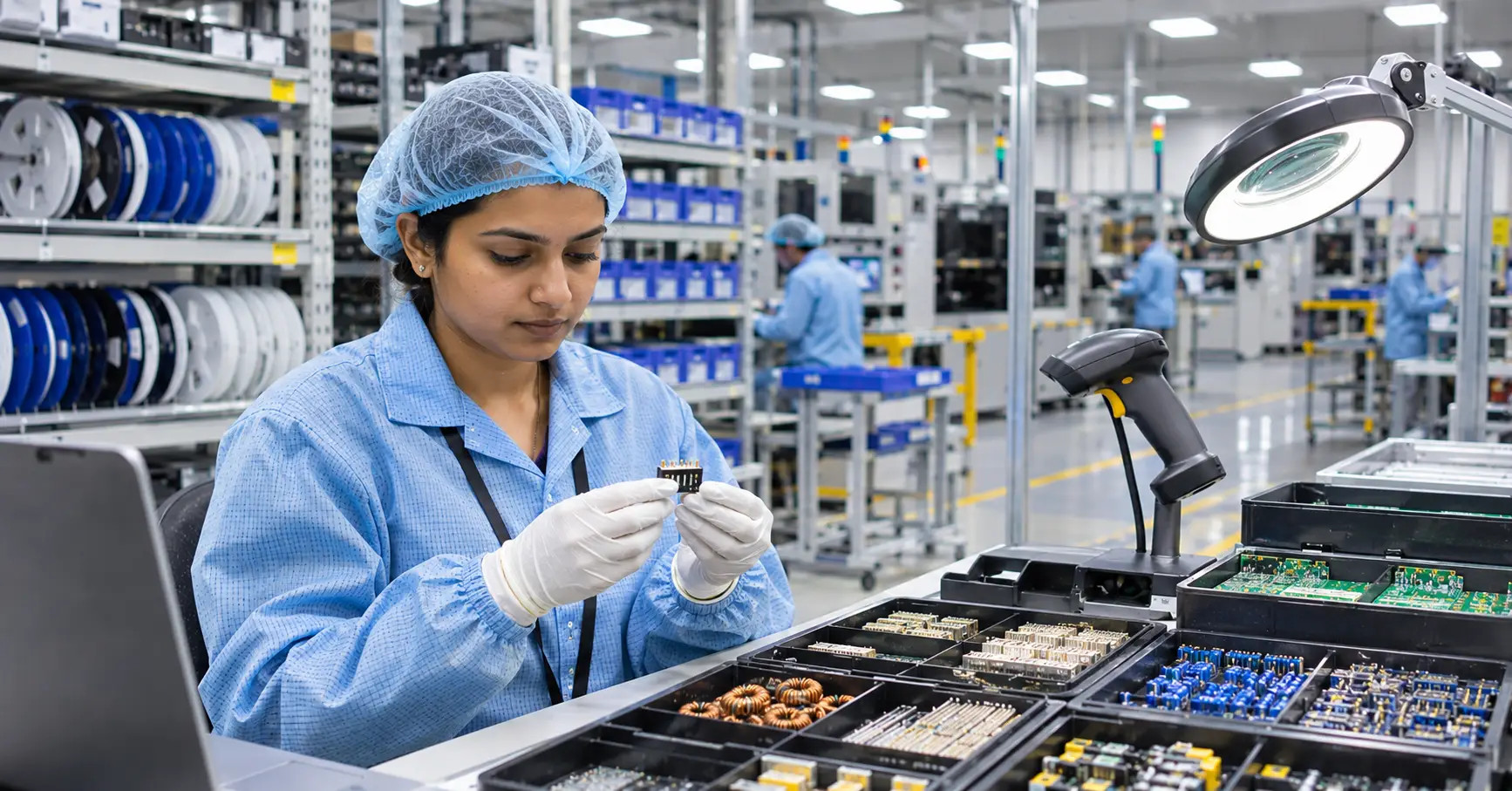
India's electronics manufacturing story is moving beyond assembling finished products. The next stage is about building a deeper domestic ecosystem for the components, sub-assemblies, materials and manufacturing equipment that sit behind those products.
The Electronics Components Manufacturing Scheme (ECMS) is one of the government's major initiatives supporting this transition. Notified on 8 April 2025, the scheme was initially launched with an outlay of ₹22,919 crore. The Union Budget 2026–27 subsequently increased the ECMS outlay to ₹40,000 crore, reinforcing the policy focus on domestic component manufacturing.
For India's telecom and electronics industry, the significance of ECMS goes beyond individual component factories. A stronger domestic component base can influence sourcing, supply-chain resilience, manufacturing lead times, value addition and the ability of Indian manufacturers to participate more deeply in global electronics value chains.
What Is the Electronics Components Manufacturing Scheme?
ECMS is designed to encourage investment in the domestic manufacturing of electronics components, sub-assemblies, supply-chain products and related capital goods.
The scheme was notified with a six-year tenure and an optional one-year gestation period, while capital expenditure incentives are available for five years. Its broader objective is to build a stronger and more self-sustaining electronics component ecosystem in India rather than relying predominantly on imported inputs.
The scheme also complements India's wider electronics and semiconductor manufacturing initiatives by strengthening the component layer that connects semiconductor and electronics production with finished products.
Why Component Localisation Matters for Electronics Manufacturing
A finished smartphone, telecom device, IT product or connected electronic product depends on a large network of components and sub-assemblies. If critical inputs have to travel through long or concentrated international supply chains, manufacturers can face longer lead times, currency exposure, logistics disruptions and sourcing uncertainty.
Component localisation can address some of these challenges by developing domestic production capacity closer to India's growing electronics manufacturing base.
Localisation can potentially help manufacturers with:
- Shorter and more responsive supply chains
- Greater domestic value addition
- Improved access to critical components
- Closer supplier-manufacturer collaboration
- Faster engineering and product-development feedback
- Greater resilience against external supply disruptions
Localisation does not mean every component must immediately be manufactured domestically. A more practical approach is to develop competitive local capacity in components and materials where scale, technology, economics and strategic importance support domestic production.
Which Components and Products Does ECMS Cover?
ECMS covers multiple layers of the electronics value chain rather than focusing on a single product category.
Approvals announced by the government have included products such as multi-layer PCBs, camera modules, connectors, antennas, capacitors, heat sinks, lithium-ion cells, relays, resistors, transducers, flexible PCBs, inductors and display modules. Supply-chain products such as copper-clad laminates, metallised films and rare-earth permanent magnets have also been included, alongside manufacturing capital equipment.
This breadth is important because the competitiveness of an electronics ecosystem depends on more than final assembly. The availability of materials, components, sub-assemblies and production equipment can influence the cost, speed and scalability of downstream manufacturing.
How ECMS Is Strengthening India's Electronics Supply Chain
The scheme's impact is increasingly visible in the number and diversity of approved projects.
As of August 2026, 106 projects across 15 states had been approved under ECMS, covering 30 electronic product domains and representing approved investment of ₹69,548 crore. The approved projects were expected to generate ₹5.34 lakh crore in production, along with 74,628 direct and 2.5 lakh indirect jobs. Production had already started at 38 approved plants, while another 16 projects were at advanced construction or machinery-installation stages.
These numbers indicate that the programme is moving beyond policy announcement toward physical manufacturing capacity.
What ECMS Means for the Telecom Electronics Supply Chain
Telecom equipment depends on a broad mix of electronic and electromechanical components, including PCBs, connectors, antennas, passive components, power-related parts, enclosures and other specialised assemblies.
As more of these inputs become available domestically, telecom manufacturers can potentially build a more diversified sourcing base within India.
This matters for products such as:
- Network equipment
- Routers and gateways
- Optical networking equipment
- Wireless communication devices
- Enterprise connectivity hardware
- Other telecom and networking products
The objective is not simply to replace imports one component at a time. A deeper domestic ecosystem can allow manufacturers, component suppliers and system integrators to develop stronger relationships and improve coordination across the value chain.
From Assembly to a Deeper Electronics Value Chain
India has already developed significant capacity in finished electronics manufacturing. The next challenge is to capture more value upstream.
ECMS is designed to encourage this shift by supporting component and material manufacturing alongside sub-assemblies and capital equipment. The government's March 2026 approvals, for example, included display modules, antennas, connectors, heat sinks, Li-ion cells, flexible PCBs, inductors, copper-clad laminates and rare-earth permanent magnets.
This can create a multiplier effect. A domestic component manufacturer can supply multiple downstream manufacturers, while local OEMs and EMS companies gain access to a broader supplier ecosystem.
What Does This Mean for EMS and Electronics Manufacturers?
For EMS companies, deeper component localisation can change the way procurement and manufacturing are managed.
A broader domestic supplier base can create opportunities for:
- More flexible sourcing strategies
- Closer supplier qualification and quality management
- Shorter replenishment cycles for selected components
- Greater coordination between design and manufacturing teams
- More opportunities for product customisation
- Higher domestic value addition
At the same time, localisation brings its own requirements. Domestic suppliers need to meet demanding standards for quality, consistency, capacity, cost and delivery. Building a component ecosystem therefore requires investment not only in factories but also in engineering, testing, skilled manpower and supplier development.
Why Design and Supply-Chain Capability Matter Together
Component manufacturing becomes more valuable when it is connected to product design and downstream manufacturing requirements.
In March 2026, the Ministry of Electronics and Information Technology highlighted four priority areas for the next stage of electronics manufacturing: stronger in-house design capabilities, robust domestic supply chains, quality programmes and workforce development.
This highlights an important point: localisation is not simply a procurement exercise. Manufacturers need to understand component specifications, qualification requirements, engineering changes and production constraints throughout the product lifecycle.
How ECMS Could Support India's Global Electronics Ambitions
A deeper component ecosystem can make India more attractive as a manufacturing base for both domestic and global electronics companies.
When components, sub-assemblies, production equipment and finished-product manufacturing capabilities develop together, manufacturers can potentially reduce supply-chain friction while increasing domestic value addition.
For global companies, this can also support supply-chain diversification and provide another manufacturing location integrated into global electronics production networks.
Optiemus and India's Electronics Manufacturing Ecosystem
Optiemus Infracom operates across India's mobility, telecom and electronics ecosystem. Through Optiemus Electronics Limited (OEL), the group manufactures telecom products, IT hardware, mobile devices and hearables and wearables.
OEL's manufacturing capabilities include Surface Mount Technology (SMT), Manual Insertion (MI) and Final Assembly, Testing & Packaging (FATP), providing manufacturing support for global and Indian customers.
As India's component ecosystem develops, these downstream manufacturing capabilities can form part of the broader value chain connecting locally manufactured components and sub-assemblies with finished electronic products.
Explore Optiemus' electronics manufacturing capabilities in India.
What Should Electronics Companies Watch Next?
For businesses operating in telecom and electronics, the development of the component ecosystem is likely to influence sourcing and manufacturing decisions over the coming years.
Companies should watch developments in:
- Domestic component capacity
- Supplier qualification and quality standards
- Component cost competitiveness
- Availability of specialised materials
- Manufacturing equipment localisation
- Design and engineering capabilities
- Integration with global supply chains
The most important question will not simply be how many components are manufactured in India. It will be whether the ecosystem can deliver the quality, scale, technology and supply reliability required by global electronics manufacturers.
Conclusion
The Electronics Components Manufacturing Scheme (ECMS) represents an important step in India's transition from an assembly-focused electronics industry toward a deeper manufacturing ecosystem.
With the ECMS outlay increased to ₹40,000 crore in Union Budget 2026–27 and more than 100 projects approved by August 2026, the programme is already supporting capacity across components, sub-assemblies, materials and manufacturing equipment.
For the telecom and electronics supply chain, the long-term opportunity is broader than import substitution. It is about building stronger domestic supplier networks, increasing value addition, improving resilience and enabling Indian manufacturers to participate more deeply in global electronics value chains.
As this ecosystem develops, manufacturers with strong electronics assembly, testing and production capabilities will be increasingly important in connecting component localisation with finished products.
Learn more about Optiemus' electronics manufacturing capabilities.
Frequently Asked Questions
What is the Electronics Components Manufacturing Scheme (ECMS)?
ECMS is a Government of India initiative designed to support domestic manufacturing of electronics components, sub-assemblies, supply-chain products and related capital equipment.
What is the current ECMS outlay?
The scheme was initially notified with an outlay of ₹22,919 crore. The Union Budget 2026–27 increased the ECMS outlay to ₹40,000 crore.
How does ECMS support component localisation?
The scheme supports investment across multiple layers of the electronics value chain, including components, sub-assemblies, supply-chain products and capital equipment, helping expand domestic manufacturing capacity.
Why is component localisation important for telecom manufacturing?
A stronger domestic component ecosystem can provide telecom manufacturers with additional sourcing options, improve supply-chain resilience and increase domestic value addition while supporting closer coordination between suppliers and manufacturers.
How can ECMS benefit electronics manufacturers?
By expanding domestic availability of components and materials, ECMS can create opportunities for more resilient sourcing, stronger supplier networks, greater value addition and deeper integration into India's electronics manufacturing ecosystem.
