

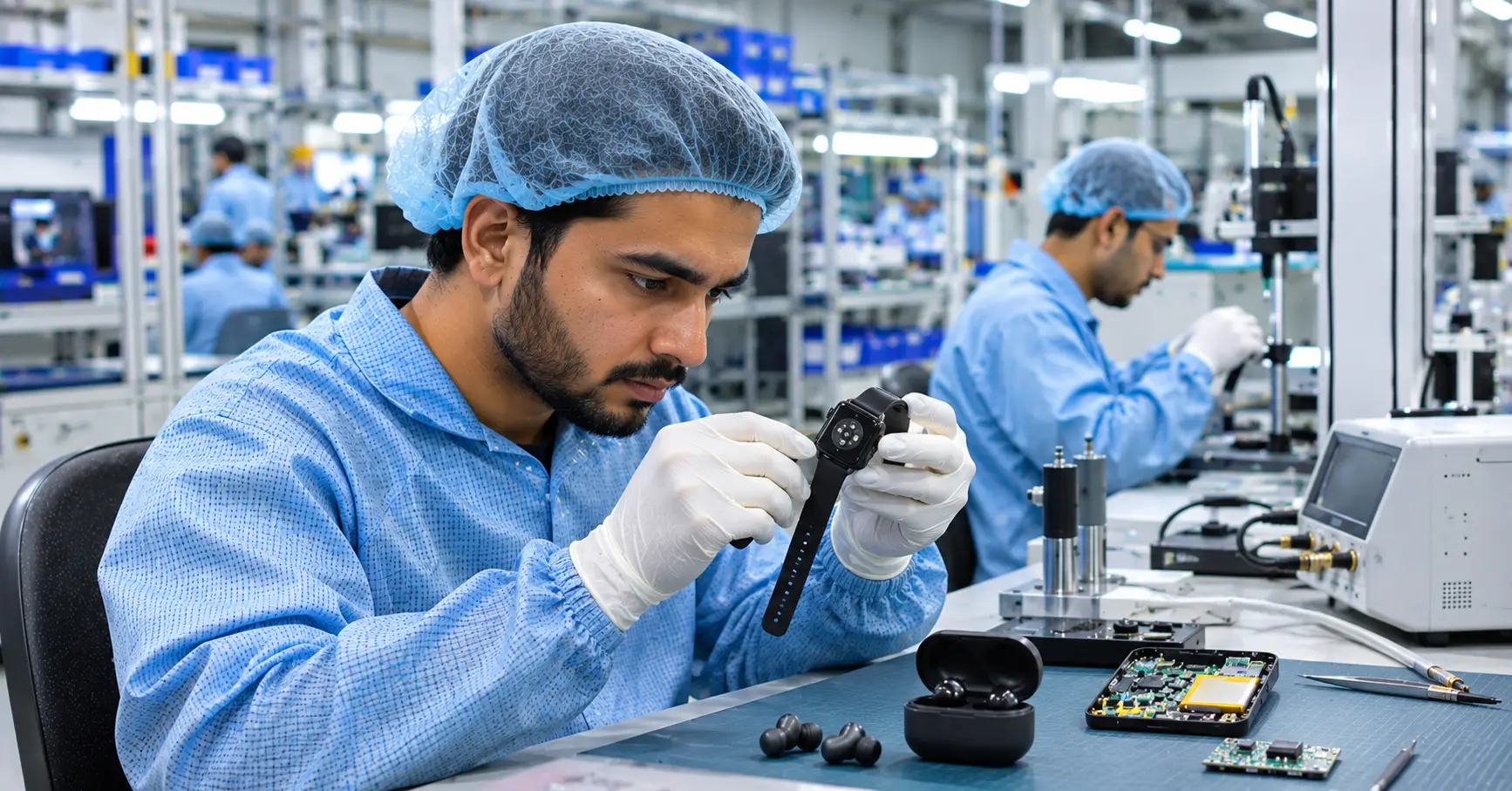
Hearables and wearables are evolving from connected accessories into increasingly intelligent computing devices. TWS earbuds, smartwatches, smart rings, smart glasses and other wearable products can now combine sensors, microphones, connectivity and local processing to understand more about their users and surroundings.
The important change is that some of this intelligence is moving closer to the device itself. Instead of sending every input to a smartphone or cloud server, on-device AI can process selected workloads locally, helping reduce latency, limit data transmission and enable more responsive experiences.
For manufacturers, this changes more than the software layer. AI-enabled products can require different processors, sensor configurations, power-management strategies, memory, firmware, calibration and testing processes.
What Is On-Device AI in Hearables and Wearables?
On-device AI refers to running AI inference directly on the device rather than depending entirely on remote cloud processing.
In wearables, this can be particularly useful because devices operate under tight constraints around battery capacity, size, heat and computing resources. Small models can process selected inputs locally while more demanding workloads can still be handled by a connected smartphone or cloud service.
Current industry research indicates that Edge AI is becoming increasingly important across wearables, with TWS earbuds and smartwatches among the categories expected to drive adoption. Local processing can support functions such as health monitoring, gesture recognition and contextual awareness while reducing latency and the need to continuously transmit sensitive data.Counterpoint Research
Why AI Changes the Hardware Architecture
Adding AI to a wearable is not simply a matter of installing an application. The hardware needs to collect, process and respond to data efficiently.
Depending on the product, an AI-enabled device may require:
- More capable processors or dedicated AI acceleration
- Microcontrollers for low-power continuous sensing
- Multiple microphones for voice and environmental sound processing
- Motion and biometric sensors
- Additional memory for local models and data processing
- Efficient power-management systems
- High-speed wireless connectivity
- Firmware capable of coordinating sensors and AI workloads
Qualcomm's 2026 wearable platform developments, for example, highlight integrated NPU-based processing for on-device AI and the industry's movement toward more capable wearable computing. Qualcomm
Health Sensors Are Expanding the Role of Wearables
Health sensing is one of the areas where AI can add value to wearable devices. Sensors can continuously collect physiological or behavioural signals, while local algorithms can help interpret patterns and generate useful feedback.
Depending on the product and its intended use, sensors may monitor information such as:
- Heart rate and related cardiac signals
- Blood oxygen levels
- Movement and activity
- Sleep-related patterns
- Temperature
- Stress-related indicators
- Motion and orientation
Hearables are also attracting interest as potential sensing platforms. Research has explored the use of microphones and the ear as a location for collecting physiological information, including signals associated with movement and breathing. European Commission CORDIS
For manufacturers, this creates a new requirement: sensors must not only be present, but must be positioned, assembled and calibrated consistently enough for the intended algorithms to work reliably.
Voice Intelligence Is Turning Hearables Into AI Interfaces
Voice interaction is another major driver of AI-enabled hearables. Earbuds already contain microphones, speakers, wireless connectivity and compact processors, making them a natural platform for hands-free interaction.
AI can enable features such as voice commands, speech enhancement, real-time audio processing, translation and interaction with digital assistants.
Industry developments in 2026 are increasingly positioning hearables as interfaces for Personal AI, where voice, audio, connectivity and local intelligence work together. Qualcomm
This also increases the importance of microphone performance, acoustic design, noise handling and low-power always-on processing.
Always-On AI Creates a Power Challenge
One of the biggest manufacturing constraints for AI-enabled wearables is power consumption.
Consumers expect earbuds and watches to remain small and lightweight while providing long battery life. Running a processor continuously can consume valuable energy, so manufacturers increasingly need architectures that keep low-power sensing active and wake more powerful processing only when required.
Intelligent sensors and low-power microcontrollers can help support functions such as wake-word detection, voice activity detection and health monitoring without continuously activating the main processor. Bosch Sensortec
This creates a manufacturing trade-off between processing capability, battery capacity, device size, thermal behaviour and expected runtime.
What Changes on the Manufacturing Line?
AI-enabled products can introduce additional manufacturing and quality requirements across the production lifecycle.
At the Surface Mount Technology (SMT) stage, manufacturers need accurate placement of processors, memory, sensors, microphones, wireless components and other miniature components.
During final assembly, mechanical positioning can become particularly important for devices that depend on microphones, optical sensors, biometric sensors or other components whose physical location affects performance.
Testing may also need to go beyond conventional electrical checks to validate sensor operation, wireless connectivity, microphone performance, charging behaviour, firmware and product-specific AI functions.
Calibration Becomes More Important
AI depends on the quality of the information supplied by sensors. Manufacturing variation can therefore affect the quality of the data available to an algorithm.
Depending on the device, manufacturers may need controlled procedures for sensor calibration, microphone testing, motion sensing, battery validation and functional verification.
For example, two wearable devices with identical components can produce different results if sensor placement, assembly tolerances or calibration parameters vary significantly.
This makes manufacturing consistency an important part of the overall AI product experience.
Testing AI-Enabled Hearables and Wearables
Testing needs to cover both the conventional electronics and the new intelligent functions.
A comprehensive manufacturing test strategy may include:
- PCB and component inspection
- Electrical and functional testing
- Sensor validation and calibration
- Microphone and speaker testing
- Bluetooth and wireless connectivity checks
- Battery and charging tests
- Firmware verification
- Final product inspection
The exact test sequence depends on the product architecture. A smartwatch, TWS earbud and smart ring will not require identical manufacturing tests.
Why AI Changes Product Development and Manufacturing Together
AI-enabled wearables demonstrate why product engineering and manufacturing can no longer be treated as completely separate stages.
A product team may design an AI feature around a particular sensor, processor or microphone arrangement. Manufacturing then needs to reproduce that architecture consistently at scale.
This creates a feedback loop between:
Product Design → Hardware → Sensors → Firmware → Manufacturing → Testing → Product Performance
The earlier manufacturing constraints are considered during product development, the easier it can be to identify potential issues with component availability, assembly, calibration, testing and production scalability.
What Manufacturers Need to Consider
Brands developing AI-enabled hearables and wearables should evaluate manufacturing partners across more than production capacity.
Important considerations include:
- SMT and miniature electronics assembly capability
- Experience with sensor-based products
- Firmware loading and functional testing
- Calibration processes
- Reliability and quality systems
- Traceability across production
- Ability to support new product introduction
- Scalability from pilot production to mass manufacturing
The goal is to ensure that the manufacturing process can preserve the performance expected from the product's AI and sensor architecture.
Optiemus and Hearables & Wearables Manufacturing
Optiemus Electronics Limited (OEL) currently manufactures hearables and wearable products alongside mobile devices, telecom products and IT hardware. OEL's manufacturing infrastructure includes Surface Mount Technology (SMT), Manual Insertion (MI) and Final Assembly, Testing & Packaging (FATP). Optiemus manufacturing capabilities
Optiemus' corporate information also records a milestone of one million hearable and wearable units manufactured by OEL in a single month. Its current manufacturing capabilities provide a relevant foundation for brands developing connected electronics that require high-volume electronics assembly, testing and production support. Optiemus company profile
The Manufacturing Opportunity Ahead
AI is changing hearables and wearables from passive devices into systems that can sense, interpret and respond.
For manufacturers, that means the challenge is no longer limited to assembling smaller electronics. Production processes must increasingly account for sensors, local processing, acoustic systems, power constraints, calibration and software-hardware interaction.
As AI moves closer to the device, manufacturing quality becomes even more important because the physical consistency of the product can influence the quality of the data and intelligence it delivers.
Conclusion
AI-enabled hearables and wearables are creating a new category of intelligent consumer electronics. On-device processing can support faster responses and more private experiences, while health sensors and voice intelligence are expanding what these devices can do.
For manufacturers, this evolution creates new requirements across component selection, SMT assembly, sensor integration, calibration, power management, firmware and functional testing.
The manufacturing partner therefore needs to understand not only how to assemble the device, but also how its hardware, sensors and software work together.
Optiemus Electronics Limited's experience in hearables and wearables manufacturing, combined with its SMT, Manual Insertion and FATP capabilities, provides a foundation for supporting connected electronics at production scale.
As intelligence moves increasingly onto the devices people wear every day, the factories behind those products will need to become equally precise, connected and adaptable.
Learn more about Optiemus' electronics manufacturing capabilities.
Frequently Asked Questions
What are AI-enabled hearables and wearables?
AI-enabled hearables and wearables are connected devices that use sensors, processors and AI algorithms to interpret information and provide intelligent functions such as voice interaction, activity recognition, health-related insights or contextual assistance.
What is on-device AI in wearables?
On-device AI means that selected AI processing happens directly on the wearable rather than relying entirely on a cloud server. This can support lower latency and reduce the amount of sensitive data that needs to be transmitted.
How are health sensors changing wearable manufacturing?
Health-focused products require accurate sensor integration, controlled placement, calibration and functional testing. Manufacturing consistency becomes important because sensor performance can influence the quality of the information processed by the device.
Why is power management important for AI wearables?
Wearables have limited battery capacity and compact form factors. Manufacturers therefore need to balance AI processing capability with power consumption, thermal behaviour, device size and expected battery life.
What should brands look for in an AI wearable manufacturing partner?
Brands should evaluate SMT capability, sensor integration, calibration, firmware and functional testing, reliability systems, traceability, new product introduction support and the ability to scale from pilot production to mass manufacturing.
