

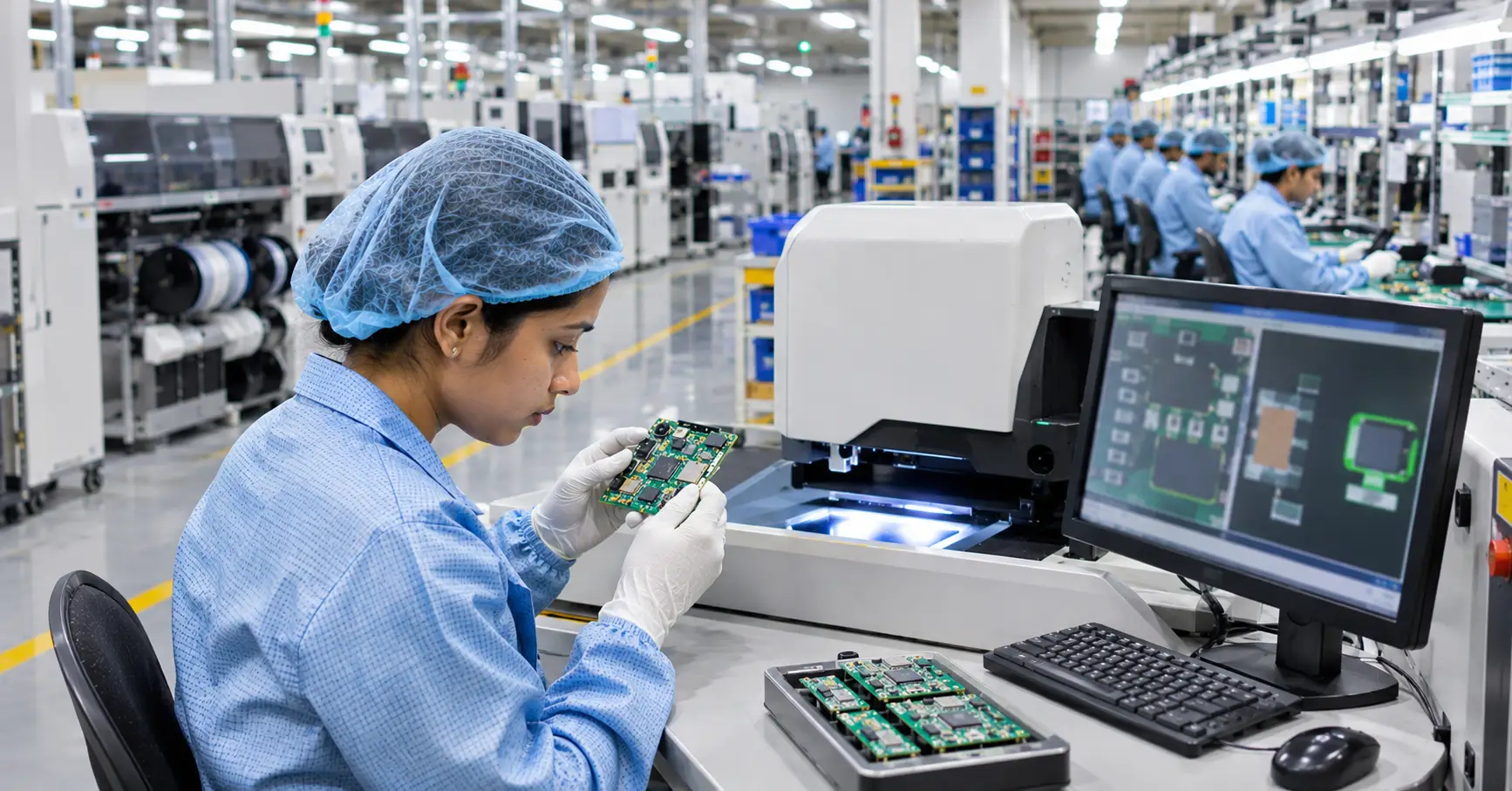
Electronics manufacturing is becoming more complex as products become smaller, component density increases and production volumes rise. At the same time, manufacturers are under constant pressure to improve quality, reduce rework and maintain consistent production yields.
Artificial intelligence is beginning to change how manufacturers approach these challenges. Instead of using AI only for automation or data analysis, manufacturers are increasingly applying machine learning and computer vision to inspection, defect classification, process monitoring and quality improvement.
For electronics manufacturers, the opportunity is particularly relevant across Surface Mount Technology (SMT) and Final Assembly, Testing & Packaging (FATP), where large volumes of production data are generated every day.
What Does AI Mean for Electronics Manufacturing?
AI in electronics manufacturing refers to the use of machine learning, computer vision, pattern recognition and data analytics to support manufacturing decisions and processes.
Traditional automated inspection systems typically operate using predefined rules, thresholds and programmed parameters. These systems remain important, but AI can add another layer by learning patterns from production data and helping distinguish genuine defects from normal process variation.
This creates a shift from simply asking “Is this product defective?” to asking:
- What type of defect has occurred?
- Where in the process did it originate?
- Is the defect becoming more frequent?
- Which process parameters may be contributing to it?
- Could the problem affect future production?
The objective is not to replace every existing manufacturing system. It is to use AI alongside automation, inspection equipment, manufacturing data and human expertise to make quality decisions faster and more consistently.
How AI Is Changing SMT Inspection
SMT is one of the most data-intensive stages of electronics manufacturing. Components must be placed accurately, solder paste must be deposited correctly and solder joints must meet the required quality criteria.
Manufacturers already use technologies such as Solder Paste Inspection (SPI) and Automated Optical Inspection (AOI) to identify manufacturing defects.
AI can make these inspection systems more intelligent by analysing images and production data to identify complex patterns and classify potential defects.
AI-Powered AOI
AI-powered AOI can assist with identifying issues such as component misalignment, missing components, polarity problems, soldering defects and other visual anomalies.
One important application is reducing **false calls **situations where an inspection system flags an acceptable product for additional manual review. Recent industry work has demonstrated the use of deep learning and similarity-based methods to reduce false alarms in SMT inspection.
Reducing unnecessary alarms can help inspection teams focus their attention on genuine quality issues while maintaining appropriate quality controls.
AI in Solder Paste Inspection
Solder paste printing is an important upstream process because variations in paste deposition can contribute to downstream soldering defects.
AI-supported SPI can analyse inspection information to identify patterns in solder paste deposits and help manufacturers understand whether a process is moving away from its normal operating condition.
The important change is that inspection data can become useful for process improvement, rather than being limited to a pass-or-fail decision.
From Defect Detection to Yield Improvement
Yield represents how much acceptable product a manufacturing process produces compared with the total production output. Improving yield means reducing defects, rework and scrap while maintaining the required quality level.
AI can support yield improvement by connecting information from different manufacturing stages.
For example, an AI system could analyse relationships between inspection results, component information, machine parameters and production batches to identify recurring patterns.
This can help manufacturing and quality teams investigate questions such as:
- Which defect types occur most frequently?
- Which production stage is associated with them?
- Are defects concentrated around a particular component or product revision?
- Are inspection results changing between production batches?
- Is a process parameter moving outside its normal range?
Research and industrial deployments increasingly focus on this transition from defect detection toward process intelligence and yield optimization.
How AI Can Support FATP Quality Control
AI is not limited to PCB inspection. It can also support quality control during Final Assembly, Testing & Packaging (FATP).
At the final assembly stage, products contain multiple electronic and mechanical components that need to work together correctly. Depending on the product, inspection can involve visual appearance, assembly accuracy, connectors, displays, cameras, labels, mechanical fit and other product-specific characteristics.
Computer vision can assist with identifying visual and assembly anomalies, while AI-based analytics can help correlate final-test results with information collected earlier in the production process.
This creates the possibility of a more connected quality workflow:
SMT → Inspection → Assembly → Functional Testing → Quality Analysis → Process Improvement
The benefit comes from connecting information across these stages rather than treating each inspection point as an isolated checkpoint.
AI Can Help Move Quality Control Upstream
Traditional quality management often identifies problems after they have already occurred. AI can support a more proactive approach by identifying patterns that indicate a process may be moving toward failure.
For example, if inspection data shows that a particular defect is becoming increasingly common, manufacturers can investigate the relevant process before the problem creates larger quantities of rework or rejected products.
This does not mean that AI can predict every manufacturing failure. Production conditions change, models require representative data and AI outputs still need appropriate validation and engineering oversight.
Current research also highlights limitations around data quality, false positives, changing production conditions and the difficulty of scaling AI inspection systems from pilots into high-volume manufacturing.
What Data Does AI Need on a Manufacturing Line?
The effectiveness of an AI system depends heavily on the quality and relevance of the data available to it.
Potential sources can include:
- AOI and SPI inspection images
- Component and material information
- Machine and process parameters
- Production batch information
- First-pass and final-test results
- Defect classifications
- Rework and repair records
- Product and process revisions
Connecting this information can give manufacturing teams a more complete view of where quality issues originate and how they develop across the production process.
AI Does Not Replace Manufacturing Engineers
One of the biggest misconceptions around AI manufacturing is that artificial intelligence can operate independently of manufacturing expertise.
In reality, successful AI deployment requires cooperation between production engineers, quality teams, manufacturing specialists and technology teams.
Engineers still need to define acceptable quality limits, validate AI outputs, investigate root causes and decide what corrective action should be taken.
AI is therefore best viewed as a decision-support capability that can process large volumes of manufacturing information and highlight patterns that may otherwise take much longer to identify.
What AI Means for Future Electronics Manufacturing
As electronics products become smaller and more complex, inspection requirements are becoming more demanding. Fine-pitch components, dense PCB layouts and higher production volumes create more opportunities for subtle defects and process variation.
AI can help manufacturers respond by making inspection more adaptive, connecting quality information across production stages and supporting faster identification of recurring problems.
The direction of the industry is therefore moving from isolated automated inspection toward increasingly connected manufacturing intelligence.
Optiemus and Electronics Manufacturing in India
Optiemus Electronics Limited (OEL) provides Electronics Manufacturing Services across mobile devices, telecom products, IT hardware and hearables and wearables. Its current manufacturing capabilities include Surface Mount Technology (SMT), Manual Insertion (MI) and Final Assembly, Testing & Packaging (FATP).
These production stages are directly relevant to the evolution of AI-enabled manufacturing. SMT generates inspection and process data around PCB assembly, while FATP creates additional opportunities for final-product inspection and testing.
As AI-based manufacturing technologies mature, the combination of production infrastructure, quality systems, data and engineering expertise will become increasingly important for manufacturers looking to improve process visibility and quality control.
Explore Optiemus' electronics manufacturing capabilities.
What Should Manufacturers Consider Before Implementing AI?
AI should solve a defined manufacturing problem rather than being introduced simply because it is a new technology.
Manufacturers should first consider:
- Which quality or production problem needs to be solved?
- Is sufficient production data available?
- Are defect categories clearly defined?
- Can AI integrate with existing inspection systems?
- How will model performance be validated?
- Who will monitor and maintain the system?
- How will AI recommendations be incorporated into manufacturing workflows?
A focused deployment addressing a measurable problem can provide a stronger foundation than attempting to introduce AI across an entire factory at once.
Conclusion
AI is changing electronics manufacturing by adding intelligence to inspection, quality analysis and process optimisation. On SMT lines, AI can support SPI and AOI by helping identify complex defects and reduce unnecessary inspection alarms. Across FATP, computer vision and data analytics can support final assembly and product-quality checks.
The larger opportunity is to connect these capabilities. When inspection data from different stages is analysed together, manufacturers can move beyond detecting defects toward understanding why they occur and how processes can be improved.
For electronics manufacturers in India, the combination of advanced production infrastructure, quality systems, manufacturing data and engineering expertise will be increasingly important as products become more complex.
Optiemus Electronics Limited's SMT, Manual Insertion and FATP capabilities provide a manufacturing foundation across multiple electronics product categories. As AI-enabled manufacturing continues to evolve, such integrated production environments can provide the infrastructure needed to adopt smarter approaches to inspection, yield and quality control.
Learn more about Optiemus' electronics manufacturing capabilities.
Frequently Asked Questions
How is AI used in electronics manufacturing?
AI can be used for visual inspection, defect classification, process monitoring, anomaly detection, yield analysis and manufacturing data analysis. It can complement existing automation and inspection systems.
How does AI improve SMT inspection?
AI can analyse inspection images and production data to identify defect patterns, classify anomalies and help reduce false inspection calls. Applications include AI-assisted SPI and AOI.
Can AI improve manufacturing yield?
AI can support yield improvement by identifying relationships between defects, process parameters, components and production batches. The actual improvement depends on data quality, process conditions and how effectively corrective actions are implemented.
Can AI be used during FATP?
Yes. Computer vision and AI-based analytics can support final assembly inspection, product-quality checks and analysis of final-test results, depending on the product and manufacturing process.
Does AI replace manufacturing engineers?
No. AI systems require manufacturing and quality expertise for validation, interpretation, root-cause analysis and corrective action. AI is best used as a tool that supports manufacturing teams rather than replacing them.
